Google Ads vs SEO: Which One Should a London Business Actually Invest In? (2026 Guide)
A working framework from a London-based digital marketing consultant, with real numbers, real trade-offs, and no channel loyalty.
Introduction
Every few weeks someone books a call with me and opens with a version of the same sentence: “We’re trying to decide between Google Ads and SEO.”
It’s a fair question. It’s also, nine times out of ten, the wrong one.
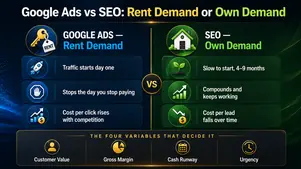
Here’s why. Google Ads and SEO aren’t competing products you pick between, like choosing a broadband provider. They’re two different ways of buying attention from the same audience at the same moment: one you rent, one you own. Asking which is “better” is a bit like asking whether a business should lease a van or buy a warehouse. Depends entirely on what you’re moving, how fast, and how long you plan to be in business.
What actually determines the answer is a set of unglamorous variables: your average customer value, your gross margin, how long your sales cycle runs, how much cash you can put at risk for ninety days, how competitive your keywords are inside the M25, and whether your website converts at all. Get those on paper and the decision usually makes itself.
The London dimension makes this sharper. Cost per click in Greater London tends to run meaningfully above equivalent keywords in Manchester, Leeds or Cardiff. You’re bidding against every agency, chain and venture-funded startup in the country, plus a fair number of international advertisers targeting the UK. At the same time, organic competition in London is brutal: search “accountant London” and you’re up against firms with twenty years of domain history and link profiles you won’t match this decade.
So the honest framing isn’t which channel wins. It’s which channel gets you to a profitable customer fastest, and what do you build behind it so you’re not renting attention forever.
This guide covers the full picture: what each channel really is in 2026, what they cost, how long they take, what quality of lead they produce, how AI search has changed the maths for both, and — most usefully — a set of decision frameworks you can run against your own numbers this afternoon.
I’ve written it for the businesses I actually work with: London service firms, UK SMEs, ecommerce brands, professional services, and startups trying to buy their first hundred customers without setting fire to a seed round.
Key Takeaways
The nine things worth remembering if you read nothing else.
- Neither channel is “better.” Google Ads buys demand today at a rising price. SEO builds an asset that compounds but pays nothing for the first two to three months.
- Google Ads is the correct first move when you have a proven offer, a converting website, a known customer value, and cash to run a genuine three-month test.
- SEO is the correct first move when your margins are thin, your customer value is low, your keywords are cheap to rank for, or your buying cycle is long and research-heavy.
- For most established London businesses, the answer is both — sequenced. Ads buy time and data; SEO reduces your long-term cost per acquisition.
- The London premium is real. Expect competitive service keywords in the capital to price well above the UK average, which shortens your margin for error on landing pages.
- AI Overviews have compressed organic click-through rates significantly on queries where they appear, but being cited inside an AI answer is now its own traffic source, and it converts unusually well.
- Lead quality and traffic volume are different problems. Paid search usually wins on speed and control. Organic usually wins on trust, cost-per-lead over time, and mid-funnel research capture.
- Your landing page decides more than your channel does. A high click-through rate with a poor conversion rate is a page problem, not an ads problem.
- If your GA4 and conversion tracking are broken, this entire debate is theoretical. Fix measurement before you argue about budget.
Table of Contents
- The Real Question Isn’t Google Ads vs SEO
- What Google Ads Actually Is in 2026
- What SEO Actually Is in 2026
- Google Ads vs SEO: The Core Differences
- What Each Channel Really Costs in the UK
- Time to Results: An Honest Timeline
- Traffic Quality, Lead Quality and Conversion Rates
- ROI: How to Compare Them Properly
- Search Intent: The Variable That Decides Everything
- Local SEO and the Google Business Profile Advantage
- How London and UK Search Behaviour Changes the Answer
- AI Search Has Changed the Maths
- The Funnel View: Where Each Channel Sits in the Customer Journey
- Landing Pages: Where Most Budgets Quietly Die
- Measurement: GA4, Search Console and Proving It Worked
- Decision Frameworks You Can Run Today
- Budget Planning by Spend Level
- Strategy by Business Type
- Common Mistakes I See Every Month
- Expert Tips
- Frequently Asked Questions
- Conclusion: The Sequence That Usually Works
1. The Real Question Isn’t Google Ads vs SEO
Let me reframe the whole thing with a scenario I’ve seen play out more times than I can count.
A Clapham-based plumbing firm comes to me with £1,500 a month to spend. The owner has been told by one person that SEO is “free traffic” and by another that Google Ads is “instant leads”. Both are wrong in the way that most half-truths are wrong: technically defensible, practically useless.
Here’s what actually mattered in that business. Average job value: around £240. Gross margin after materials and labour: roughly 45%. So each job contributes about £108. That number, not the channel, sets the ceiling on what he can pay to acquire a customer.
At a realistic cost per click for emergency plumbing terms in South London and a landing page converting at, say, 9%, his cost per enquiry lands somewhere around £45–£70. If half of those enquiries turn into jobs, his cost per customer is £90–£140. On £108 of contribution, that’s marginal on the first job and profitable only if customers come back or refer.
Suddenly the conversation isn’t “ads or SEO”. It’s:
- Can we lift the landing page conversion rate from 9% to 14%?
- Can we get the Google Business Profile into the map pack, where the clicks cost nothing?
- Can we raise average job value with a service plan?
- Can we capture repeat work through email so the second job costs nothing to acquire?
Three of those four are not paid media questions. That’s the point.
The right question is: what is the cheapest measurable route to a profitable customer for this business, right now, and what does that route look like in twelve months? Everything in this guide is a tool for answering that.
The four variables that actually decide it
| Variable | Pushes you towards Google Ads | Pushes you towards SEO |
|---|---|---|
| Customer lifetime value | High (£1,000+): you can absorb a £150 CPA | Low (under £200) — paid maths rarely works |
| Gross margin | Healthy (50%+) | Thin (under 30%) |
| Urgency / cash runway | Need customers this quarter | Can invest 6–12 months ahead |
| Competitive intensity | Organic SERP dominated by giants you'll never outrank | Winnable long-tail and local queries exist |
Scroll the table sideways to see all columns.
If three of the four point the same direction, start there. If they split, you’re in “both, sequenced” territory, which is where most real businesses land.
2. What Google Ads Actually Is in 2026
Most explanations of Google Ads stop at “you pay when someone clicks”. That’s true and it’s about as useful as saying a business is “money in, money out”.
Google Ads is an auction for intent. When someone types “commercial cleaning contract London”, Google runs an instant auction among advertisers who want that query. You don’t simply outbid people. Your position and price are determined by Ad Rank, which blends your bid, your expected click-through rate, your ad relevance, your landing page experience, and the format of your ad. Two advertisers bidding the same amount can pay very different prices for the same click.
This is the bit that catches people out: you can lower your costs without lowering your bids, by making your ads and landing pages more relevant. I’ve cut cost per click by 30% in accounts without touching a single bid, purely by restructuring campaigns so the ad text matched the query and the landing page matched the ad.
What Google Ads looks like now
The platform has changed substantially, and a lot of advice online still describes the 2019 version.
Search campaigns remain the core for lead generation. Someone types a query, you show a text ad. Highest intent, most control, still the most reliable performer for service businesses.
Performance Max is Google’s automated, cross-network campaign type. You give it assets, a budget and a conversion goal, and it distributes across Search, Shopping, YouTube, Display, Discover and Gmail. It works well for ecommerce with a clean product feed and enough conversion volume. It works badly for low-volume lead generation, where it tends to hoover up cheap, junk conversions. I’m cautious with it below roughly 30 conversions a month.
Shopping is still the workhorse for retail. Your feed quality matters more than your bids.
Demand Gen covers YouTube and Discover placements for demand creation rather than demand capture. Useful, but a different job — don’t judge it on last-click conversions.
Broad match plus smart bidding is what Google pushes hardest. It can work brilliantly with strong conversion data and disciplined negative keyword management. Without both, it’s an expensive way to appear for queries that have nothing to do with your business.
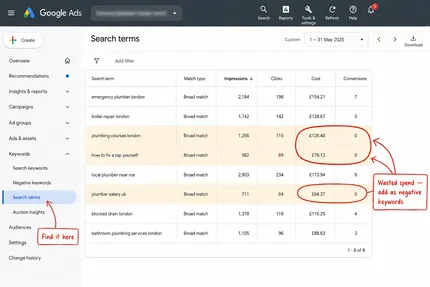
WarningThe single most expensive mistake in a small Google Ads account: letting broad match run with automated bidding and no negative keyword list. I’ve audited accounts where 40% of spend went to queries the owner would have rejected instantly if he’d seen them. Check your Search Terms report weekly for the first three months. Not monthly. Weekly.
What Google Ads is genuinely good at
- Buying qualified traffic within hours of launch
- Testing whether a market wants your offer, before you commit to twelve months of content
- Producing keyword and search-term data that makes your SEO strategy dramatically better
- Scaling up or down instantly when capacity or seasonality changes
- Owning bottom-of-funnel queries that organic can’t crack quickly
- Geographic precision — you can bid only in the boroughs you actually serve. (A UK retailer I worked with bought 1,670 qualified visitors for £700 largely on this discipline.)
What it’s bad at
- Building anything you keep. Stop paying, traffic stops the same day.
- Cheap traffic in expensive verticals. Legal, insurance, finance and B2B SaaS clicks in London are punishing.
- Working around a poor website. Ads amplify whatever your site already does, including failing.
- Top-of-funnel research queries, where the intent to buy simply isn’t there yet.
3. What SEO Actually Is in 2026
SEO has quietly become four separate disciplines that happen to share a name. Treating it as one blob is why so many campaigns underperform.
3.1 Technical SEO — the foundation nobody sees
This is whether Google can crawl, render, index and understand your site. Unsexy, and the most common cause of “we publish loads of content and nothing happens”.
Typical problems I find in audits:
- Pages blocked by an errant robots.txt rule left over from a staging site
- Duplicate content across parameter URLs, quietly splitting authority
- A migration that dropped several hundred redirects
- Core Web Vitals failing on mobile because a page builder loads 4MB of unused CSS
- Missing or duplicated H1s after a theme update
- Structured data that validates but describes the wrong entity
None of this is glamorous. All of it can cap your ceiling regardless of how good your content is.
3.2 Content and topical authority
The 2018 playbook — one page per keyword, 1,500 words, keyword density around 2%, is dead. Google now evaluates whether your site demonstrates genuine depth across a topic, not whether a page repeats a phrase.
Practically, that means clusters. A pillar page on a broad subject, supported by ten to twenty specific pages that answer real sub-questions, properly interlinked. Depth beats volume. Ten excellent pages that fully cover a topic will outperform sixty thin ones, and the thin ones can actively drag you down.
3.3 Local SEO
For any business serving a physical area, local SEO is a distinct discipline with its own ranking logic: proximity, relevance and prominence. Your Google Business Profile, your review velocity, your local citations and your location pages drive map pack visibility, which for a lot of London service businesses is worth more than any organic blue link.
3.4 Entity SEO and GEO (Generative Engine Optimisation)
The newest layer, and the one I spend most of my AI marketing and GEO time on. Search engines and large language models increasingly reason about entities: your business as a distinct thing, connected to services, locations, people and other entities, rather than strings of text. Getting cited by ChatGPT, Gemini, Claude, Perplexity or Google’s AI Overviews depends on being a clearly defined, corroborated, well-structured entity that these systems trust.
We’ll come back to this properly in section 12, because it’s changed the maths on both sides.
What SEO is genuinely good at
- Compounding. Traffic you earn in March is still there in November, and it costs nothing extra.
- Capturing research-stage demand that paid search can’t afford to serve
- Building credibility. Ranking organically reads as endorsement in a way that an ad label never will.
- Reducing blended cost per acquisition over time
- Feeding AI systems, which pull disproportionately from well-structured organic content
What it’s bad at
- Speed. Nothing meaningful happens in the first six to eight weeks.
- Certainty. You can do everything right and still get beaten by a stronger domain.
- Immediate scale. You can’t double organic traffic next Tuesday because a competitor went out of business.
- Volatility control. Core updates happen and you have no lever to pull on the day.
4. Google Ads vs SEO: The Core Differences
Here’s the master comparison. Everything after this section unpacks a row of it.
| Factor | Google Ads (PPC) | SEO (Organic) |
|---|---|---|
| What you're buying | Access to demand, rented by the click | An asset that generates demand |
| Speed to first lead | Hours to days | 8–12 weeks minimum, often longer |
| Cost model | Pay per click, ongoing | Pay for work, traffic is then free |
| Cost trend over time | Rises with competition | Falls per visitor as authority builds |
| Control | Very high — budget, geography, time, message | Low — you influence, you don't control |
| Predictability | High once you have data | Moderate, vulnerable to core updates |
| Scalability | Instant, limited only by budget and search volume | Slow, but with no marginal cost per visitor |
| Stops when you stop paying | Yes, same day | No, decays over months or years |
| Trust perception | Lower — users know it's an ad | Higher — earned position reads as endorsement |
| Best funnel position | Bottom (ready to buy) | Full funnel, especially middle |
| Data richness | Excellent — search terms, cost, conversions per query | Weaker — Search Console gives partial keyword data |
| Testing speed | Days | Months |
| Maintenance load | Constant, weekly minimum | Periodic, monthly to quarterly |
| AI search impact | Ads still shown above and inside AI results | Citation-dependent; strong content gains, thin content loses |
| Typical UK entry point | £750–£1,500/month ad spend + management | £600–£1,500/month for meaningful work |
Scroll the table sideways to see all columns.
| Your objective | Better first channel | Why |
|---|---|---|
| Fill the diary in the next 30 days | Google Ads | Only channel with that timescale |
| Validate a new service or product | Google Ads | Cheapest way to buy a real answer |
| Reduce cost per lead over 12 months | SEO | Fixed cost, growing return |
| Compete for "near me" and map visibility | Local SEO + GBP | Map pack sits above organic and costs nothing per click |
| Build brand credibility with buyers who research | SEO + content | People trust what they find, not what they're shown |
| Launch a seasonal campaign | Google Ads | Turn on, turn off, no lag |
| Recover from a Google core update | SEO (technical + content) | Ads can bridge the revenue gap while you fix it |
| Get cited by ChatGPT and AI Overviews | SEO / GEO | Paid placements don't earn citations |
| Sell a £30 product with 25% margin | SEO + email + retention | Paid maths rarely works at that contribution |
| Sell a £15,000 B2B service | Google Ads first, SEO alongside | High LTV absorbs high CPC comfortably |
Scroll the table sideways to see all columns.
5. What Each Channel Really Costs in the UK
Let’s talk numbers, with an important caveat up front: every published benchmark is an average of wildly different accounts, and averages hide more than they reveal. Use these as orientation, not as a forecast. Your own account data beats any industry report within about six weeks.
5.1 The Google Ads cost structure
Three separate costs, and people routinely forget the third.
- Media spend — what Google takes. Entirely yours to set.
- Management — either your time, or a freelancer/agency fee. UK freelance management typically runs from a few hundred pounds a month for a small account upwards; agencies commonly charge a percentage of spend with a floor.
- Conversion infrastructure — landing pages, tracking, call tracking, CRM integration. This is the cost people skip, and it’s the one that decides whether the other two were worth spending.
Published UK CPC benchmarks for 2026 vary a great deal by source, which tells you something in itself. Reported cross-industry Search Network averages sit somewhere in the region of £2–£3.50 per click, with reports of year-on-year increases in the high teens as a percentage. The spread by sector is far more meaningful than the average:
| Sector | Indicative UK CPC range | Notes |
|---|---|---|
| Legal services | £8–£18+ | The most expensive category, consistently |
| Insurance and finance | £7–£15 | Aggregators dominate; CPCs punishing |
| B2B SaaS | £3–£6 | High LTV usually justifies it |
| Home services / trades | £2.50–£6 | Emergency terms cost the most |
| Healthcare and dental | £2.50–£6 | Private treatment terms run high |
| Education and training | £1.50–£4 | Wide variance by course value |
| Ecommerce / retail | £0.40–£1.50 | Shopping keeps blended CPC low |
| Arts, events, hospitality | £0.80–£2 | Among the cheapest |
Scroll the table sideways to see all columns.
The London premium. Multiple UK benchmark reports put Greater London CPCs above equivalent national keywords, commonly in the region of 15–30% higher. It’s not hard to see why: denser advertiser competition, higher commercial value per customer, and a lot of national advertisers who geo-target London first. Practically, this means a London campaign needs either a higher-value customer or a better-converting landing page than the same campaign in Sheffield. Usually both.
5.2 The SEO cost structure
SEO costs are labour, not media. You’re buying hours of technical work, strategy, writing, and outreach.
Reported UK market rates for 2026 cluster roughly like this:
| Tier | Typical monthly | What it realistically buys | Suitable for |
|---|---|---|---|
| Budget | £200–£500 | Basic on-page work, occasional content, a report | Very small local businesses; expect slow progress |
| Mid-range | £500–£1,500 | Technical audit and fixes, keyword strategy, 2–4 content pieces, some link work, monthly reporting | Most UK SMEs — the commonest bracket |
| Established | £1,500–£3,000 | Full content programme, structured link acquisition, CRO input, competitive analysis | Ecommerce and competitive service markets |
| Premium | £3,000–£10,000+ | Multi-market, enterprise technical work, digital PR | Large ecommerce, multi-location, national brands |
Scroll the table sideways to see all columns.
Below roughly £500 a month in a competitive London vertical, be realistic about what you’re buying. That budget buys a few hours of someone’s time. It doesn’t buy a campaign.
| Google Ads | SEO | |
|---|---|---|
| Month 1–3 outlay | £4,500 (spend + management) | £3,000 |
| Leads months 1–3 | ~55 | ~4 |
| Month 4–12 outlay | £13,500 | £9,000 |
| Leads months 4–12 | ~170 | ~120 |
| Total 12-month cost | £18,000 | £12,000 |
| Total leads | ~225 | ~124 |
| Cost per lead | £80 | £97 |
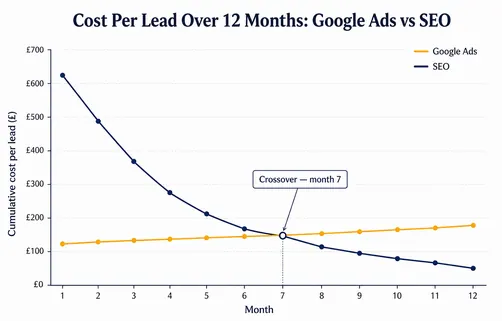
| Cost per lead, month 12 only | £78 (flat) | £43 (falling) |
| Position at month 13 | Back to zero if you stop | Asset still producing |
Scroll the table sideways to see all columns.
That last pair of rows is the entire argument in miniature. Paid search hands you a flat cost per lead forever. SEO hands you a terrible cost per lead early and an excellent one late. Which you prefer depends on how long you intend to be in business, and whether you can survive the early months.
Expert tipWhen a client can only afford one, I ask a blunt question: “If this doesn’t produce a return for five months, does the business still exist?” If the answer is anything other than a confident yes, start with ads. Cash flow beats theory.
6. Time to Results: An Honest Timeline
The vaguest promises in this industry are made about timing. Here’s a realistic version, based on how campaigns actually behave rather than how proposals describe them.
| Timeframe | Google Ads | SEO |
|---|---|---|
| Week 1 | Live, first clicks, first data | Audit, keyword research, technical fixes begin |
| Weeks 2–4 | First conversions; search terms revealing waste | Technical fixes shipped, first content published |
| Month 2 | Bid strategies stabilising; CPA improving | Early indexing, impressions rising, few clicks |
| Month 3 | Reliable, forecastable performance | First real ranking movement on long-tail terms |
| Month 4–6 | Optimisation and scaling; testing new campaign types | Meaningful traffic growth; first commercial keywords land |
| Month 6–12 | Incremental efficiency gains; diminishing returns without new markets | Compounding growth; authority pages start ranking for terms you didn't target |
| Month 12+ | Flat cost per lead unless you change something | Cost per lead falls; brand searches rise |
Scroll the table sideways to see all columns.
Two caveats worth stating plainly.
Google Ads is fast to traffic, not fast to profit. Give a new account three months before you judge it. Smart bidding needs conversion data before it can do its job; judging a campaign at three weeks is judging an algorithm that hasn’t finished learning.
SEO on a brand-new domain is slower than SEO on an established one. A six-year-old site with existing links will move in eight weeks. A domain registered last month competing in “London” queries may take nine months to do anything you’d celebrate. Anyone quoting you a fixed timeline without looking at your domain hasn’t looked at your domain.
7. Traffic Quality, Lead Quality and Conversion Rates
This is where the debate gets genuinely interesting, because the received wisdom is split, and both halves are partly right.
The case for paid leads being better: you control the query, the message and the page. Someone clicking an ad for “emergency electrician Islington” is about as qualified as a stranger gets. You can bid only on commercial-intent terms and exclude the researchers entirely.
The case for organic leads being better: they arrived by choice rather than by placement, they’ve often consumed more of your content before enquiring, and there’s no ad-scepticism discount. In most accounts I’ve measured, organic leads close at a somewhat higher rate and haggle less, though they’re slower to arrive and harder to attribute.
| Dimension | Google Ads | SEO |
|---|---|---|
| Intent control | Excellent — you choose the queries | Partial — you rank for what you rank for |
| Volume of top-funnel traffic | Low by design | High |
| Time on site | Typically lower | Typically higher |
| Enquiry-to-sale rate | Good on commercial terms | Often better |
| Price sensitivity | Higher — people compare ads | Lower — trust built before contact |
| Lead volume predictability | High | Moderate |
| Junk lead risk | Real, especially with broad match or PMax | Lower, but spam form fills happen |
| Attribution clarity | Strong | Weak, and getting weaker |
Scroll the table sideways to see all columns.
On conversion rates
Published 2026 benchmarks for Google Ads Search conversion rates land somewhere around 4–8% across industries, depending on whose dataset you read, with home services and legal at the higher end and ecommerce nearer 2–3%. Several 2026 reports note conversion rates falling year on year across most sectors.
That decline matters more than the absolute number. If CPCs are rising and conversion rates are falling, cost per acquisition is being squeezed from both ends, which is precisely why the businesses winning on paid search right now are the ones obsessing over landing pages rather than bid strategies.
Expert tipA high click-through rate with a low conversion rate is almost never an ads problem. It means your ad is writing a cheque your landing page can’t cash. Before you touch bids, load the page on a mid-range Android phone on 4G and try to enquire. Most people have never done this on their own site.
8. ROI: How to Compare Them Properly
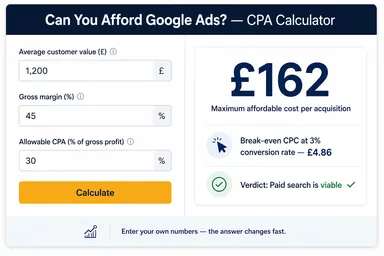
Here’s where I’d like you to stop reading passively and get a calculator out.
The only three numbers that matter first
- Average customer value — what a customer is worth over their lifetime, not on the first purchase.
- Gross margin — what’s left after delivering the thing.
- Maximum allowable cost per acquisition (CPA), usually somewhere between 20% and 40% of gross profit per customer, depending on how much you want to keep.
If a customer is worth £2,000 at 60% margin, that’s £1,200 gross profit. At a 30% allowable CPA, you can spend £360 to acquire one. That’s a healthy paid search budget. If a customer is worth £60 at 30% margin — £18 of gross profit — you can spend about £5.40. In most UK verticals, £5.40 buys you between one and two clicks. Paid search is structurally the wrong channel for that business until the average order value or repeat rate improves.
The break-even worked example
Take a London commercial cleaning company (the structure below mirrors how I model every account. You can see the same maths applied to real budgets in my case studies):
- Average contract value: £8,400 per year
- Gross margin: 35% → £2,940 gross profit
- Allowable CPA at 25%: £735
- Cost per click on commercial cleaning terms in London: assume £4.50
- Landing page converts at 6% → cost per enquiry = £75
- Enquiry-to-contract rate: 15% → cost per customer = £500
£500 against a £735 allowable CPA. That works, with room to spare. This business should be running Google Ads today, not debating it, and should be running SEO simultaneously so that in eighteen months a meaningful share of those contracts arrives without an auction.
Now run the same maths on a business selling £45 skincare products at 40% margin with a 20% repeat rate. Gross profit per customer: roughly £22. Allowable CPA at 30%: £6.60. That business needs SEO, email, retention and organic social, with paid search reserved for branded terms and remarketing, if at all.
| Google Ads | SEO | |
|---|---|---|
| Return profile | Immediate, linear, capped by budget | Delayed, then exponential |
| Measurability | Direct and near-complete | Partial, improving with proper GA4 setup |
| Payback period | Days to weeks | 6–12 months typically |
| Marginal cost of the next customer | Same or higher (auction pressure) | Approaching zero |
| Risk of total loss | Low — you see waste quickly | Moderate — an algorithm update can undo work |
| Compounding effect | None | Substantial |
| Effect on business valuation | Minimal — it's an expense | Positive — organic visibility is an asset |
Scroll the table sideways to see all columns.
Expert tipTrack blended CAC, not channel CAC. Divide total marketing spend by total new customers, every month. Channel-level attribution is increasingly unreliable. Cookie restrictions, iOS privacy, dark social, AI referrals that arrive without a referrer. Blended CAC is crude, but it’s honest, and it can’t be gamed by whichever platform is claiming the credit.
9. Search Intent: The Variable That Decides Everything
If I could get every business owner to internalise one concept, it would be this one. Search intent explains why two campaigns with identical budgets produce wildly different results.
Every query carries an intent. Match the channel to the intent and things work. Mismatch them and you’re paying to interrupt people who weren’t going to buy anyway.
| Intent type | Example query | Best channel | Why |
|---|---|---|---|
| Transactional | "book emergency plumber Clapham" | Google Ads | Ready now; paying £6 for the click is rational |
| Commercial investigation | "best CRM for small UK law firms" | SEO (comparison content) | Researching, not buying; expensive to serve with ads |
| Local | "accountant near me" | Local SEO + GBP, then Ads | Map pack sits above organic and costs nothing per click |
| Informational | "how does VAT work for sole traders" | SEO | Almost never worth paying for |
| Navigational / branded | "your company name" | SEO, with cheap defensive Ads | Should be free; defend only if competitors bid on you |
| Comparison | "Xero vs QuickBooks UK" | SEO | High-value mid-funnel; AI systems love this format |
| Problem-aware | "why is my website not ranking" | SEO + content | The top of a long journey; nurture, don't sell |
Scroll the table sideways to see all columns.
The strategic insight buried in that table: paid search and SEO are strongest at opposite ends of the same journey. Ads own the last three feet. SEO owns everything before it. A business running only ads is buying customers who were already at the finish line, and paying whatever the auction demands, because it never influenced them earlier. A business running only SEO builds an audience it may struggle to convert at the moment of decision.
Run both and something useful happens: your content earns the trust, and your ads capture the transaction. Cost per acquisition falls in the paid account because more of the clicks come from people who already know your name.
Expert tipUse your Google Ads Search Terms report as free keyword research for SEO. It shows you the exact phrases real people type and which of those phrases convert. That’s better data than any keyword tool sells, because it’s tied to money. I’ve built entire content strategies out of a ninety-day search terms export.
10. Local SEO and the Google Business Profile Advantage
For any business with a service area, this section may matter more than the previous nine combined.
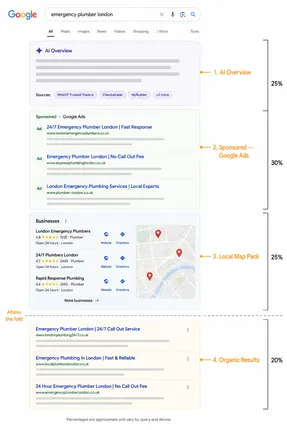
Local search operates on different mechanics: proximity (how close you are to the searcher), relevance (how well your profile matches the query), and prominence (reviews, citations, links, general notability). Get those right and you appear in the Local Pack: the map with three business listings that sits above the organic results, and often above or alongside the ads.
The reason this deserves its own section: Local Pack clicks are free. Industry data consistently shows local intent accounting for a very large share of Google searches, with the map pack appearing at or near the top for the overwhelming majority of local queries and capturing a substantial share of the clicks. Businesses in the pack see meaningfully more calls, direction requests and website clicks than those ranked below it.
So for a London business, the highest-ROI first move is often neither Google Ads nor traditional SEO. It’s fixing the Google Business Profile, which is why local SEO sits at the front of almost every local engagement I run.
The Google Business Profile checklist
- Primary category set correctly — this single field influences rankings more than most people believe
- Secondary categories added for genuine additional services
- Service areas defined by borough or postcode, not “London” as a blob
- Complete services list with descriptions
- Business description written for humans, containing your main service and location naturally
- Opening hours accurate, including bank holidays
- 20+ genuine photos, refreshed quarterly, geotagged where sensible
- Review acquisition running continuously — velocity matters more than total count
- Every review responded to, including the bad ones, especially the bad ones
- Q&A section seeded with the questions customers actually ask
- Google Posts published at least monthly
- Messaging enabled if you can genuinely respond within the hour
- NAP (name, address, phone) identical across your website, GBP and all major UK directories
- Location pages on your site for each area you serve, with genuinely different content
WarningDo not create thin location pages. Twenty near-identical pages differing only by borough name is a classic doorway-page pattern and Google handles it accordingly. If you can’t write 500 genuinely distinct words about your work in Hackney (real projects, local specifics, area-relevant detail), don’t make the page.
Where this leaves the ads-versus-SEO question: if you’re a local London business without a properly optimised Google Business Profile, you’re arguing about which channel to fund while ignoring free visibility above both of them. Fix that first. It takes a fortnight and costs nothing.
11. How London and UK Search Behaviour Changes the Answer
Advice written for the American market gets applied to London businesses constantly, and it misleads in specific ways.
Competitive density is the defining feature. In most UK cities, ranking for a competitive service term means beating maybe fifteen serious competitors. In London it can mean beating several hundred, including national brands who target the capital first, agencies with dedicated SEO teams, and venture-funded startups who don’t need the campaign to be profitable this year. That’s why my honest advice to a new London business is frequently to not chase “[service] London” for the first year, and instead own borough-level and long-tail terms where you can actually win.
Borough-level search behaviour is real. Londoners search by neighbourhood, not by city. “Dentist Shoreditch”, “accountant Canary Wharf”, “physio Wimbledon”. These terms have lower volume, dramatically lower competition, and considerably higher intent than the city-wide equivalent. In paid search they’re also cheaper. This is where small London businesses win.
Mobile and “near me” dominate local intent. Local queries skew heavily to mobile, and the behaviour is impatient. A decision made in seconds, from a map result, often without visiting a website at all. If your phone number isn’t one tap away, you’ve lost people who were ready to buy.
UK-specific commercial patterns worth knowing:
- British searchers use “cost” and “price” in queries more readily than American equivalents, and comparison content performs strongly here
- “Near me” volumes have grown substantially and continue to
- Trust signals matter disproportionately — Companies House registration, VAT number, professional body membership, a real London address
- Seasonality is sharper than most people plan for: August is quiet across most B2B verticals, December collapses for professional services and explodes for retail
- Reviews on Google carry more weight for local decisions than any other single trust factor
Expert tipRun a geographic performance report in Google Ads segmented by London borough after your first sixty days. You will almost certainly find two or three boroughs producing enquiries at half your average cost and two or three producing nothing. Reallocating budget on that basis is the single easiest efficiency win available to a London advertiser, and almost nobody does it.
12. AI Search Has Changed the Maths
This is the section that dates fastest, so let me be careful to separate what’s established from what’s still moving.
What’s actually happened
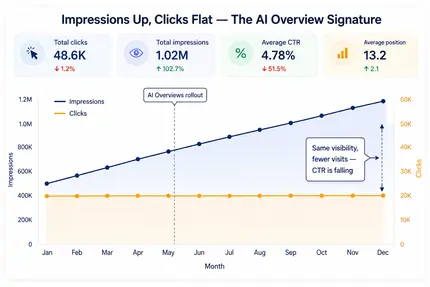
Google’s AI Overviews now appear on a large and growing proportion of searches. Reporting in early 2026 put it near half of all queries, though the figure varies enormously by query type. Informational queries attract them constantly; transactional queries far less so.
The effect on organic click-through rates has been substantial. The most-cited study, from Seer Interactive across billions of impressions, found organic CTR on AI-Overview queries at roughly 0.6% versus 1.6% on queries without one, a compression of around 60%. Other methodologies report smaller declines, in the 15–30% range. There’s been a partial recovery through early 2026 as Google adjusted the format, but the gap between AI-present and AI-absent queries hasn’t closed.
Here’s the part most coverage misses, and it changes the strategy completely:
Brands cited inside AI Overviews appear to gain traffic, not lose it. Research indicates cited brands receiving substantially more organic clicks, and notably more paid clicks — than brands sitting at position one beneath an AI answer they weren’t cited in. Being in the AI answer is now a distinct and valuable position.
Meanwhile, ChatGPT, Perplexity, Gemini and Claude have become referral sources in their own right. Volume is still small. ChatGPT sends a tiny fraction of Google’s traffic, but growth has been steep, roughly tripling year on year by early 2026. And the quality is notable: multiple studies report AI-referred visitors converting significantly better than standard organic traffic, in some cases by a wide margin. The logic is intuitive. Someone who arrives after an AI has explained their options and recommended you is much further along than someone who clicked the fourth blue link.
| Impact on Google Ads | Impact on SEO | |
|---|---|---|
| Informational queries | Largely unaffected; few ads there anyway | Significant CTR loss |
| Transactional queries | Minimal impact; ads still prominent | Modest impact |
| Local queries | Minimal — map pack still dominant | Minimal |
| Comparison queries | Ads increasingly served in AI surfaces | High risk and high citation opportunity |
| Overall traffic volume | Broadly stable | Lower clicks per impression |
| Traffic quality | Stable | Higher — surviving clicks are more considered |
| New opportunity created | Ads appearing within AI experiences | Citation as a visibility channel |
Scroll the table sideways to see all columns.
What this means practically
For SEO: the game has shifted from ranking to being quotable. Content that gets cited by AI systems tends to share characteristics: direct answers stated early, clear structure, specific figures, named sources, genuine expertise, clean structured data, and a well-defined entity behind it. Thin listicles are being eaten alive. Substantive, opinionated, specific content is doing better than ever.
For Google Ads: the picture is more stable than the panic suggests. Commercial-intent queries still show ads prominently, and Google has strong incentives to keep it that way. If anything, as organic clicks compress on informational queries, the relative value of owning transactional queries via paid search has gone up.
I’ve written separately about why your business needs to show up in ChatGPT answers and about entities and topical authority in 2026, both of which go deeper than there’s room for here.
For the ads-versus-SEO decision: AI search has slightly strengthened the case for paid search in the short term and substantially changed what kind of SEO is worth doing. The businesses hurt most are those with large volumes of thin informational content. The businesses gaining are those producing genuinely authoritative material: the sort that gets named in an answer.
WarningBe sceptical of any AI-search statistic quoted without a methodology. The published figures for AI Overview CTR impact range from a 15% decline to a 61% decline depending on the study, the query set and the date. Anyone quoting a single confident number is selling something. Track your own Search Console impressions-to-clicks ratio over time. That’s the only dataset that describes your site.
13. The Funnel View: Where Each Channel Sits in the Customer Journey
Channel arguments usually collapse the moment you draw the customer journey properly.
| Stage | What the customer is doing | Primary channel | Supporting channel | Typical content |
|---|---|---|---|---|
| Unaware | Doesn't know they have the problem | Organic content, social | Demand Gen / YouTube | Educational articles, guides |
| Problem-aware | Searching symptoms and causes | SEO | Remarketing | "Why is X happening" content |
| Solution-aware | Comparing approaches | SEO | Ads on comparison terms | Comparison pages, case studies |
| Vendor-aware | Shortlisting providers | SEO + Local SEO | Google Ads | Service pages, reviews, pricing |
| Ready to buy | Searching to transact | Google Ads + Local Pack | Branded SEO | Landing pages, GBP, quote forms |
| Post-purchase | Deciding whether to return | Remarketing | Onboarding, retention sequences |
Scroll the table sideways to see all columns.
Look at the middle rows. That’s where most B2B and considered-purchase revenue is genuinely won, and it’s almost entirely organic territory. Paid search struggles there because the queries are expensive relative to their conversion rate. You’re paying transactional prices for research-stage traffic.
This is the real reason “just run ads” fails for professional services and considered purchases. A solicitor doesn’t get instructed because someone clicked an ad at the exact moment of need. They get instructed because the prospect read three articles, formed a view, then searched the firm by name. The ad may take the final click and the credit. The content did the work.
Practical consequence: if your sales cycle is longer than a week, your paid search attribution is systematically overstating ads and understating content. Look at assisted conversions and branded search volume before you cut the content budget.
14. Landing Pages: Where Most Budgets Quietly Die
I’ll be direct, because this is where I recover the most money for clients: the landing page is usually the constraint, and almost nobody treats it that way.
Consider two identical campaigns spending £2,000 a month at £4 a click. That’s 500 clicks.
- Page A converts at 3% → 15 enquiries → £133 each
- Page B converts at 9% → 45 enquiries → £44 each
Same spend, same traffic, same market. Three times the return. No bid change would ever produce that improvement, and the page change is a one-off cost while a bid change is permanent extra spend.
The same applies to organic. Ranking first for a valuable term and converting at 1.5% is a slower, more expensive way to fail. This is the entire argument for treating conversion rate optimisation as a channel in its own right rather than a nice-to-have.
What actually moves conversion rates
Message match. The headline should echo the query. If someone searched “commercial cleaning contract London” and lands on a page headed “Welcome to Our Company”, you’ve broken the thread. Dedicated pages per campaign, not a homepage for everything.
Proof above the fold. Real client names, real numbers, real reviews. Not stock photography of people in headsets.
One clear action. Every additional option reduces the odds of any single one being taken. Multiple CTAs offering the same action are fine; multiple different actions are not.
Form friction. Every field costs you completions. Ask for what you need to have the first conversation, not what your CRM would ideally hold.
Mobile speed. If your page takes six seconds on 4G, a meaningful share of visitors leave before it renders. You paid for every one of them.
Trust signals for UK buyers. Companies House number, VAT registration, professional accreditations, a real address, a real phone number that a person answers.
Objection handling. Price, timescale, contract length, what happens next. Handle these on the page rather than hoping the enquiry form does it.
Expert tipBefore increasing your ad budget by 20%, spend two weeks improving the landing page. A conversion rate improvement is permanent and applies to every channel simultaneously: paid, organic, social, email, AI referrals. A budget increase applies only while you keep paying it. I’ve never regretted this order of operations.
15. Measurement: GA4, Search Console and Proving It Worked
If your tracking is wrong, everything above is a philosophy seminar. And in my experience, most tracking is at least partly wrong. It’s the reason analytics and measurement is a service line rather than a checkbox.
The failures I find most often
- GA4 installed but no key events configured, so nothing is measured as a conversion
- Conversions double-counting because the tag fires through both GTM and a plugin
- Form submissions tracked but phone calls invisible, which is fatal for service businesses where most enquiries are calls
- Thank-you page tracking that breaks silently after a site redesign
- Consent Mode implemented incorrectly, so a large share of UK/EU traffic goes unmodelled
- Google Ads conversions imported from GA4 and tracked natively, inflating everything
- No offline conversion import, so the CRM knows which leads became customers and the ad platform doesn’t
That last one deserves emphasis. If you’re optimising Google Ads towards form fills rather than towards closed business, you’re teaching the algorithm to find people who fill in forms. Those are not the same people who sign contracts. Importing qualified-lead and closed-won stages back into Google Ads is one of the highest-leverage things a lead-gen advertiser can do, and it’s still uncommon among SMEs.
| Metric | Google Ads | SEO |
|---|---|---|
| Primary success metric | Cost per qualified lead / ROAS | Organic leads and revenue |
| Leading indicator | Impression share, CTR, search terms quality | Impressions, average position, indexed pages |
| Lagging indicator | CPA, ROAS, lifetime value by campaign | Organic conversions, branded search volume |
| Warning sign | Rising CPC with flat conversions | Rising impressions with flat clicks |
| Tool | Google Ads + GA4 + CRM | Search Console + GA4 + rank tracking |
| Review cadence | Weekly | Monthly |
| Minimum honest judgement window | 90 days | 6 months |
Scroll the table sideways to see all columns.
A note on attribution in 2026
Attribution is getting less reliable, not more. Cookie restrictions, privacy legislation, dark social, and now AI referrals that often arrive with no referrer at all. Some ChatGPT and Perplexity traffic lands in GA4 as direct.
Practical response, in order of usefulness:
- Ask every enquirer how they found you. One field. Imperfect, self-reported, and still more informative than most dashboards.
- Track blended CAC monthly. Total spend divided by total new customers.
- Watch branded search volume in Search Console. It’s the cleanest available proxy for whether your top-of-funnel work is landing.
- Run geographic or timing holdout tests. Pause ads in one borough for a fortnight and see what actually happens to total enquiries. Uncomfortable, unbeatable.
16. Decision Frameworks You Can Run Today
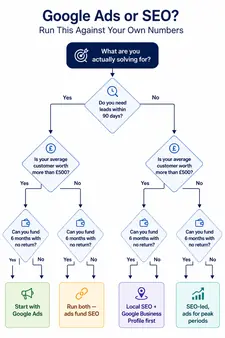
Three frameworks. Run them in order.
Framework 1 — The viability test (five minutes)
Answer honestly:
- Do you know your average customer value and gross margin? No → fix this first. Nothing else is calculable.
- Is your allowable CPA at least 15× the CPC in your sector? No → paid search is structurally difficult; lead with SEO and conversion work.
- Does your website currently convert at 2% or better? No → fix the page before funding either channel.
- Can you fund three months without a return? No → ads only, tightly targeted, branded and highest-intent terms.
- Will your business still exist in eighteen months? Yes → start SEO now regardless of what else you do.
Framework 2 — The channel scorecard
Score each statement 0 (strongly disagree) to 5 (strongly agree).
Google Ads column
- We need enquiries within 30 days
- Our customer is worth over £500
- Our margins are above 40%
- We have a dedicated landing page ready
- We can commit at least £1,000/month for three months
- Our service is bought urgently rather than researched
SEO column
- We can wait 4–6 months for meaningful returns
- Our customers research before buying
- Our competitors’ content is weak or outdated
- We can produce or fund genuine expert content
- We plan to be in this market for years
- We have a physical location or defined service area
Reading it: Ads score 8+ higher → start with paid. SEO score 8+ higher → start with organic. Within 7 points → run both, splitting roughly 65/35 towards ads in months 1–3, rebalancing to 50/50 by month six.
Framework 3 — The 90-day sequence for a typical London SME
Days 1–14 — Foundations. GA4 and conversion tracking audited and fixed. Google Business Profile fully optimised. One properly built landing page for your highest-value service. Technical SEO audit.
Days 15–45 — Buy data. Launch tightly targeted Search campaigns on exact and phrase match only, borough-level geo-targeting, aggressive negative keywords, single-service ad groups. Review search terms twice a week. Simultaneously publish two substantial pieces of content targeting commercial-investigation queries.
Days 46–90 — Compound. Use search-term data to build the SEO keyword map. Expand what converts in ads, kill what doesn’t. Publish four to six more content pieces built around proven converting queries. Begin review acquisition and local citation cleanup. Set up remarketing.
Day 90 — Decide with evidence. You now have real cost per lead, real conversion rates by query, real close rates, and early organic movement. Allocate the next six months on data rather than opinion.
17. Budget Planning by Spend Level
| Monthly budget | Recommended split | Rationale |
|---|---|---|
| Under £500 | 100% local SEO + GBP + one landing page | Too little to run a meaningful paid test. Spending £300 on ads in London buys noise. |
| £500–£1,000 | 70% ads / 30% foundational SEO | Enough for a narrow, high-intent paid test. SEO limited to technical fixes and one page a month. |
| £1,000–£2,500 | 60% ads / 40% SEO | The commonest SME position. Ads fund the pipeline, SEO builds the asset. |
| £2,500–£5,000 | 50% ads / 40% SEO / 10% CRO | Add structured conversion testing. At this level page improvements pay for themselves fastest. |
| £5,000–£10,000 | 45% ads / 35% SEO / 10% CRO / 10% content & digital PR | Link acquisition and PR become viable and start to matter. |
| £10,000+ | 40% ads / 30% SEO / 15% CRO / 15% brand & AI visibility | Diversify. Diminishing returns set in on any single channel. |
Scroll the table sideways to see all columns.
Two rules that apply at every level.
Never spend 100% of a marketing budget on media. If everything goes to clicks, nothing goes to the page those clicks land on. A sensible floor is 10–15% on conversion infrastructure.
Don’t split a small budget three ways. £600 spread across ads, SEO and social produces three underfunded efforts and no learning. Concentrate, get to a result, then diversify.
18. Strategy by Business Type
18.1 Local service businesses (trades, clinics, salons, garages)
Lead with local SEO. The Google Business Profile is your highest-return asset and its clicks are free. Optimise it fully, build review velocity, create genuine borough-level pages.
Add Google Ads for urgency terms only. Emergency and same-day queries convert immediately and justify high CPCs. Ignore research terms entirely.
Watch out for: call tracking. If most enquiries are phone calls and you’re not tracking them, you’re flying blind and will likely conclude that ads don’t work when they do.
18.2 Ecommerce
Lead with Google Ads — specifically Shopping. Feed quality is the whole game: titles, images, GTINs, product types, sale price annotations. A well-structured feed will outperform a bigger budget with a poor one. A Dutch grocery ecommerce brand I ran returned 746% ROAS on precisely that principle.
SEO focus: category pages and buying guides, not product pages. Product pages rarely rank for competitive head terms; category and comparison content does.
Then: email and retention. If your paid CAC exceeds first-order gross profit — normal in ecommerce — repeat purchase rate is what makes the business viable. Retention is a growth channel, not an afterthought.
Watch out for: judging Performance Max on last-click. It will happily claim credit for branded and remarketing conversions that would have happened anyway. Segment branded traffic out before you evaluate it.
18.3 Professional services (legal, accountancy, consultancy, finance)
Lead with SEO and content. These are researched purchases with long consideration windows. Comparison and explainer content does the persuading; the final click is often branded.
Use Google Ads selectively. CPCs here are the highest in the market. Restrict to your highest-value services and tightest geographies. A £15 click is fine if the client is worth £20,000; it’s ruinous if you’re bidding on generic terms.
Watch out for: attribution. Your ads will look better than they are and your content will look worse. Check assisted conversions and branded search growth before reallocating budget.
18.4 Startups
Lead with Google Ads — as research, not as growth. The fastest, cheapest way to learn whether the market wants your thing at your price. A £2,000 test that proves nobody clicks your value proposition is money extremely well spent.
Start SEO in parallel but modestly. Technical foundations, a clean site architecture, and two or three genuinely excellent pieces of content. You’re planting, not harvesting.
Watch out for: scaling paid spend before product-market fit. Ads amplify what exists. If the offer isn’t landing, more budget just proves it faster and more expensively.
18.5 Multi-location London businesses
Both, structured by location. Individual Google Business Profiles per site, genuine location pages, geo-segmented ad campaigns with borough-level bid adjustments.
Watch out for: cannibalisation between your own locations in the ad auction, and duplicate-content problems across location pages.
19. Common Mistakes I See Every Month
- Judging Google Ads at three weeks. Smart bidding needs conversion volume to learn. Ninety days, or don’t start.
- Sending ad traffic to the homepage. The homepage is a menu. A landing page is an answer.
- Treating SEO as a content-volume exercise. Forty thin posts will not beat six genuinely authoritative ones, and may actively hurt.
- No negative keyword list. The single largest source of wasted spend in small accounts.
- Cutting SEO the moment ads work. You’re cutting the thing that reduces your ad costs later, because more people would have searched your name.
- Ignoring the Google Business Profile. Free visibility above both paid and organic. Astonishing how often it’s neglected.
- Optimising towards form fills rather than revenue. Teaches the algorithm to find form-fillers, not customers.
- Chasing “[service] London” from a standing start. Own the boroughs and the long tail first, then earn the head term.
- Letting Performance Max run unsupervised in a lead-gen account. Below meaningful conversion volume it tends to find the cheapest, worst conversions available.
- Publishing content nobody searches for. Check search demand exists before you commission 2,000 words about it.
- Never reading the search terms report. Everything you need to improve the account is in there, and it’s free.
- Believing attribution dashboards uncritically. Every platform overstates its own contribution. Blended CAC and a “how did you hear about us” field are your corrective.
- Assuming AI search killed SEO. It changed what kind of SEO works. Thin content lost. Authoritative content is being cited more than ever.
- No plan for what happens after the enquiry. Speed of response predicts close rate more strongly than almost any marketing variable. Leads that sit in an inbox overnight go cold.
20. Expert Tips
Tip 01Buy your own brand name, but check first. If competitors are bidding on your brand, defend it; branded clicks are cheap and convert extremely well. If nobody is, you may be paying for clicks you’d have received free. Pause it for a fortnight and watch total conversions, not just paid ones.
Tip 02Run ads for a month before commissioning any SEO content. The search terms report will tell you which topics people actually search and which convert. That’s a better content brief than any keyword tool produces.
Tip 03Use dayparting on service businesses. If nobody answers the phone after 6pm and your form response time is next-morning, your evening clicks convert at a fraction of daytime clicks. Check performance by hour before assuming 24/7 is correct.
Tip 04Write your best content for the queries you can’t afford to advertise on. Expensive CPC usually signals commercial value. If a click costs £14, that’s exactly the term worth six months of organic effort.
Tip 05Add a “how did you hear about us?” field. One question. It will regularly contradict your analytics, and it’s often closer to the truth.
Tip 06Review your Google Business Profile categories quarterly. Google adds and renames them. A more accurate primary category can shift map rankings without any other work.
Tip 07Structure content so an AI can quote it. Answer the question directly in the first two sentences under each heading, use specific numbers, cite sources, and keep your structured data clean. That’s what earns citations now.
21. Frequently Asked Questions
Is SEO or Google Ads better for a small business in London?
Neither is universally better. Google Ads suits small businesses that need enquiries within weeks, know their customer value, and can fund a three-month test. SEO suits businesses with thinner margins, longer horizons, or lower-value customers where paid clicks can’t pay for themselves. For most established London SMEs the strongest position is both: ads generating cash flow and data while SEO reduces long-term acquisition cost.
How long does SEO take to work in the UK?
Expect the first meaningful movement at 8–12 weeks on long-tail terms, with commercial keywords typically landing between months four and eight. New domains take considerably longer than established ones, and competitive London terms longer still. Anyone promising page one in thirty days is describing terms nobody searches.
Is Google Ads worth it if I only have £500 a month?
In most London verticals, marginally. £500 buys roughly 100–150 clicks at typical service-sector CPCs, which is rarely enough to reach statistical confidence or to train smart bidding. If that’s your ceiling, you’ll usually get more from optimising your Google Business Profile, fixing your landing page, and doing foundational SEO. If you do run ads at that level, restrict to one service, one small geography and exact match only.
Do Google Ads help SEO rankings?
Not directly. Paid spend is not a ranking factor. Indirectly, though, ads help SEO considerably: search-term data sharpens your keyword strategy, increased brand exposure lifts branded search volume, and paid traffic gives you conversion data you can use to improve pages that also serve organic visitors.
Has AI Overviews made SEO pointless?
No, but it has changed what works. Click-through rates on queries showing AI Overviews have compressed significantly, with published estimates ranging from around 15% to 60% depending on methodology. At the same time, being cited inside an AI answer has become a valuable position in its own right, and cited brands appear to gain clicks rather than lose them. Thin, generic content has been hit hardest. Specific, well-structured, genuinely expert content is performing well.
Should I run Google Ads on my own brand name?
If competitors bid on your brand, yes — branded clicks are cheap and convert at high rates, and losing that traffic is worse than paying for it. If nobody is bidding, test pausing for two weeks and measure total conversions rather than paid conversions. Sometimes you’re buying traffic you’d have received free.
What’s a good cost per lead in the UK?
There’s no universal figure — it depends entirely on customer value. A £200 cost per lead is excellent for a firm whose clients are worth £20,000 and catastrophic for one selling £150 services. Work backwards from gross profit per customer and your target acquisition percentage instead of comparing yourself to industry averages.
Can I do SEO myself?
Parts of it, yes. A business owner can realistically manage the Google Business Profile, review acquisition, and write genuinely expert content about their own field, and that last one is often better than anything an outsourced writer produces. Technical SEO, site architecture, structured data and link acquisition benefit from experience. A common and sensible arrangement is a specialist handling the technical layer while the owner supplies the expertise.
Which channel gives better quality leads?
They’re strong in different ways. Paid leads are more controllable and usually arrive with clearer intent because you chose the query. Organic leads typically arrive better informed, close at a somewhat higher rate, and are less price-sensitive because trust was built before contact. The right comparison isn’t lead quality in isolation. It’s cost per closed customer, which requires importing sales outcomes back into your reporting.
Should ecommerce businesses prioritise Google Ads or SEO?
Usually Shopping ads first, because they reach buyers immediately and product feed quality is a controllable lever. But paid customer acquisition cost in ecommerce frequently exceeds first-order gross profit, which makes SEO (on category pages and buying guides) and email retention essential to profitability rather than optional.
How much should a London business budget for digital marketing?
A common benchmark is 5–10% of revenue for established businesses and higher for those in a growth phase, but the more useful calculation is bottom-up: how many customers do you need, what’s your realistic cost per customer, and what does that multiply out to? That produces a defensible number rather than a percentage borrowed from someone else’s business.
What if I can only afford one channel?
Ask one question: if this produces no return for five months, does the business survive? If the answer is no, run Google Ads, narrowly targeted, high-intent terms only. If the answer is yes, and especially if you’re a local business, start with local SEO and the Google Business Profile, because that’s free visibility sitting above both paid and organic results.
22. Conclusion: The Sequence That Usually Works
If you’ve read this far, you already know I’m not going to declare a winner. But I will give you the sequence I recommend most often, because after enough client accounts, patterns emerge.
First, fix the foundations. Conversion tracking that works. A landing page that converts. A complete Google Business Profile. This costs relatively little and improves the return on everything you do afterwards. Skipping it is the most expensive decision in this entire article.
Second, buy data with Google Ads. Run a tight, high-intent campaign for ninety days. You’ll get enquiries, and more valuably, you’ll get evidence: which queries convert, what a lead actually costs, which boroughs perform, what your close rate is.
Third, build the asset with SEO — informed by what the ads just taught you. Content aimed at proven converting queries. Technical foundations. Local visibility. Structured data that helps AI systems understand who you are.
Fourth, let them compound. Twelve months on, a well-run programme looks like this: paid search handling the transactional queries where speed matters, organic handling the research stage and the long tail, your brand being searched by name because people have encountered you three times before they enquired, and your blended cost per acquisition falling quarter on quarter while competitors relying on ads alone watch theirs rise with the auction.
That’s the real answer to “Google Ads or SEO”. Ads buy you time. SEO buys you independence. The businesses that grow steadily in London use the first to fund the second.
One last thing worth saying plainly. Most of the businesses I meet aren’t failing because they picked the wrong channel. They’re failing because nothing connects. The ads point at a page nobody optimised, the content targets keywords nobody validated, and the analytics were never set up to tell anyone the truth. Fix the connections and either channel works better. Fix the connections and run both, and you’ve got something durable.
Ready to Work Out Which One Your Business Actually Needs?
Every business in this article is a real pattern, but none of them is yours. The right split between paid and organic depends on numbers only you have: your customer value, your margins, your competition, your runway.
I’ll look at them with you. Book a free 30-minute consultation and we’ll go through your situation properly: what your customers are worth, what your keywords cost, what your site currently converts at, and where the cheapest measurable growth is right now. No pitch deck, no pressure, and you’ll leave with a clear recommendation whether or not we work together.
Book a free 30-minute consultation →
Prefer to start smaller? Send me your URL and I’ll reply with three things I’d fix first.
Last updated: August 2026. Benchmark figures cited in this article are drawn from published 2026 UK industry reports and should be treated as indicative ranges rather than forecasts. Costs vary substantially by sector, geography and account quality.