The Website Google Couldn’t See: My SEO Journey with Prime Academy Bangladesh
Project Information
Prime Academy Bangladesh
primeacademy.org
Education & Skills Training
SEO Specialist & Content Strategist
April 2026 – July 2026 (Ongoing)
Build organic search visibility from zero and generate qualified student enquiries.
Day One: Zero
I still remember opening Search Console for the first time after taking charge of Prime Academy’s SEO.
Zero impressions. Zero clicks. Not low numbers — zeros. As far as Google was concerned, the website didn’t exist.
Then I searched for the courses Prime Academy teaches — graphic design, digital marketing, web development. Every result on the screen belonged to competitors. Some had been ranking for years. Students were searching every day, but every click was going elsewhere.
That was the moment I realised this wasn’t simply an SEO optimisation project. It was about building search visibility from the ground up.
The Diagnosis
Before changing a single keyword or writing any content, I performed a comprehensive SEO audit of the entire website. The audit revealed several structural problems.
- Poor website hierarchy
- Thin page content
- Weak internal linking
- Orphan pages
- Crawl inefficiencies
- Low topical authority
Google couldn’t clearly understand the website or identify which pages deserved to rank. The website needed rebuilding — not simply optimisation.
Convincing Stakeholders
The audit left me with a difficult recommendation to make: restructure the website before investing any time in content creation. Asking stakeholders to pause visible work and fix the foundation first is never an easy conversation.
I walked management through the audit findings — the broken hierarchy, the orphan pages, the thin content Google was ignoring — and showed how every future SEO effort would be limited until the structure was fixed. After reviewing the findings, they agreed to rebuild first.
“Fixing the foundation first became the turning point for every SEO result that followed.”
Rebuilding the Website
Phase 1
Website Architecture
Built a logical hierarchy where every course page has a clear parent structure, so both students and search engines can understand how the site fits together.
Phase 2
Orphan Page Recovery
Integrated isolated pages into the internal linking structure and merged unnecessary pages where appropriate — so no page is left invisible to crawlers.
Phase 3
Content Improvement
Expanded thin pages into comprehensive course pages that give students everything they need to decide.
- Detailed course information
- Structured headings
- FAQs
- Improved user experience
Solving the Keyword Challenge
Keyword research in Bangladesh is a challenge in itself: search data is limited, the most obvious keywords are dominated by long-established competitors, and most research tools report low-accuracy numbers for the market.
The Challenge
- Limited search data
- Highly competitive keywords
- Low data accuracy
My Approach
- Emerging search trends
- Rising keywords
- Long-tail opportunities
- Intent-based keyword mapping
“Instead of competing for saturated keywords, every page was assigned a clear, intent-matched keyword target.”
Organic Growth
Prime Academy Bangladesh — Education & Skills Training
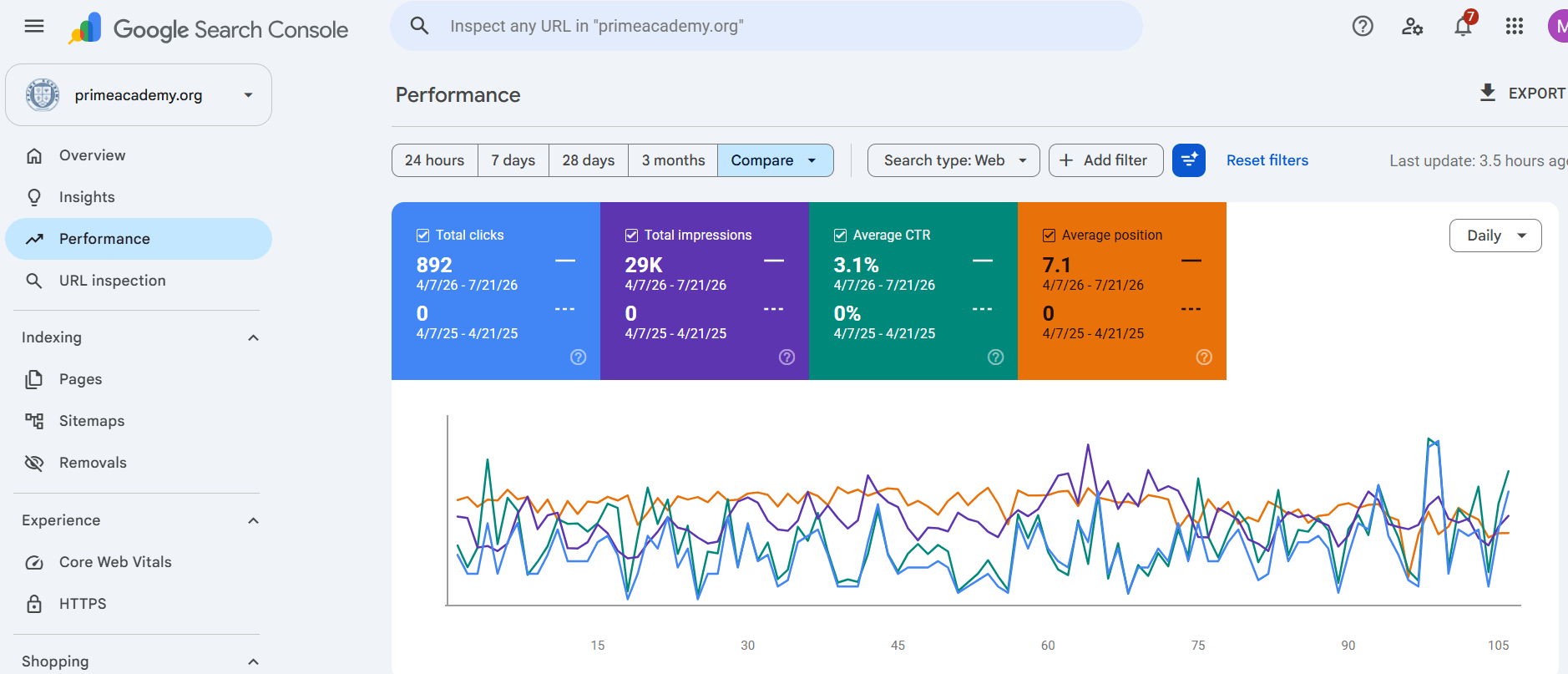
892 organic clicks, a 3.1% average click-through rate and an average position of 7.1 — organic visibility built from zero in under four months. Source: Google Search Console.
Metric
Result
Organic Clicks
↑ 892
Organic Impressions
↑ 29,000+
Average CTR
3.1%
Average Position
7.1
Growth Period
April 7 – July 21, 2026
Data Source
Google Search Console
“From zero impressions to 29,000+ Google searches — and the curve is still climbing.”
The Results
In April, the website was invisible. By late July, it had appeared in more than twenty-nine thousand Google searches — students looking for graphic design, digital marketing and web development courses were finally seeing Prime Academy alongside competitors who had been ranking for years.
Nearly nine hundred of those searchers clicked through organically, at an average click-through rate of 3.1% and an average position of 7.1 — first-page territory for a website that started at zero.
Most importantly, the trend is still upward. Rankings continue to improve week on week, and the growth curve keeps climbing rather than plateauing.
Lessons Learned
Fix Structure First
Google cannot rank pages it cannot understand. Site architecture matters more than isolated optimisation.
Audit Before Action
A comprehensive SEO audit created an actionable roadmap that prevented wasted effort.
Follow Trends
In emerging markets, identifying rising search opportunities often delivers faster growth than competing for saturated keywords.
Skills & Tools
Skills
- SEO Auditing
- Technical SEO
- Website Architecture
- Site Restructuring
- Keyword Research
- Keyword Mapping
- Content Strategy
- On-page SEO
- Internal Linking
- Orphan Page Recovery
- Link Building
- Search Console Analysis
- Stakeholder Communication
Tools
- Google Search Console
- Google Analytics 4
- WordPress
- Microsoft Excel
- Keyword Research Tools
Need Sustainable Organic Growth?
Let’s build an SEO strategy that improves your visibility, attracts qualified traffic, and delivers measurable long-term growth.
- Currently accepting new clients
- Response within 24 hours
- London, UK