How a UK E-Commerce Brand Bought 1,670 Qualified Visitors for Just £700
Project Information
UK E-Commerce Retailer
E-Commerce & Online Retail
United Kingdom
Digital Marketing and Communication Strategist
RankRezz
Full-time
21 April – 20 July 2025
Google Ads (Search & Shopping)
Online sales and efficient customer acquisition
The Starting Point
The client was a UK e-commerce retailer working with a modest advertising budget in one of Europe’s most competitive paid search markets. The budget was fixed for the duration of the campaign, so there was no option to simply spend more whenever competition intensified.
In a market where established retailers bid aggressively on high-volume commercial keywords, broad targeting would have exhausted the entire budget within days. It would have produced impressions and clicks, but very little of the purchase-ready traffic the business actually needed.
The requirement was therefore efficient customer acquisition rather than raw volume. Every pound had to buy qualified attention, and the account had to stay live and competitive across the full three-month period instead of burning out early.
I managed and optimised this Google Ads account while working as a Digital Marketing and Communication Strategist at RankRezz, where my responsibility on this account was to maximise efficiency rather than simply increase traffic.
My Responsibilities
Google Ads Campaign Architecture
Keyword Research
Intent Mapping
Bid Strategy
Search Campaign Management
Shopping Campaign Management
Budget Allocation
Negative Keyword Management
Ad Copy Testing
Performance Monitoring
Client Reporting
Analytics
Strategy
The account was built around a single constraint. With a fixed £700 budget, the objective was never to reach the largest possible audience — it was to buy the highest possible proportion of purchase-ready visits. Every structural decision below follows from that one principle.
Stage 1
Intent Filtering
High-volume, high-cost keywords were deliberately avoided. In a competitive UK market those terms attract the heaviest bidding from retailers with far larger budgets, and they pull in researchers and browsers alongside genuine buyers. Campaigns were focused instead on purchase-ready search intent — accepting lower search volume in exchange for a far higher proportion of qualified clicks.
- Purchase-ready search intent
- Expensive head terms deliberately avoided
- Qualified traffic prioritised over volume
- Lower competition and lower cost per click
Stage 2
Campaign Architecture
Campaigns were segmented into tightly themed ad groups so that every keyword sat alongside genuinely related terms and matched the ad copy served against it. Tight thematic grouping raises keyword relevance, relevance feeds directly into Quality Score, and Quality Score determines how much auction position is earned rather than bought. It also makes budget accountable: with narrow ad groups it is immediately clear which themes produce qualified clicks and which do not.
- Tightly themed ad groups
- Higher keyword relevance
- Quality Score improvements
- Budget accountability by theme
Stage 3
High-Relevance Ad Copy
Ad copy was written to match the specific intent behind each ad group rather than to describe the business in general terms. Headlines mirrored the language of the search query, descriptions reinforced the specific reason to click, and ad extensions were used to occupy more of the results page. Higher relevance produced a stronger click-through rate, and a stronger click-through rate fed back into Quality Score — which in turn lowered the cost per click.
- Intent-matched headlines
- Relevant, specific descriptions
- Ad extensions
- Higher click-through rate
- Lower cost per click
Stage 4
Negative Keyword Optimisation
Search term reports were reviewed continuously and non-commercial queries were excluded as soon as they appeared. On a fixed budget, every click bought from an unqualified query is a click that cannot be bought from a qualified one, so negative keyword work was treated as a core efficiency lever rather than routine housekeeping.
- Job searches
- Free and discount-only searches
- Research and information intent
- Competitor searches
- Low commercial intent queries
Stage 5
Daily Budget Pacing
Daily spend was monitored so the account delivered consistently across the full three-month period rather than front-loading and going dark. An average daily budget of £7.69 maintained continuous visibility, kept auction data flowing for ongoing optimisation, and gave the account the stability required to improve steadily rather than in bursts.
- Daily spend monitoring
- Consistent visibility
- Long-term optimisation
- Budget stability
Continuous Optimisation
Efficiency at this level is not achieved at launch — it is maintained. The account was worked on continuously throughout the campaign period, with each review cycle feeding the next round of refinements.
- Weekly Search Term Reviews
- Negative Keyword Expansion
- Keyword-Level Bid Optimisation
- CTR Analysis
- Quality Score Improvements
- Ad Copy Testing
- Budget Reallocation
- Performance Reporting
Campaign Results
UK E-Commerce Retailer — Search & Shopping
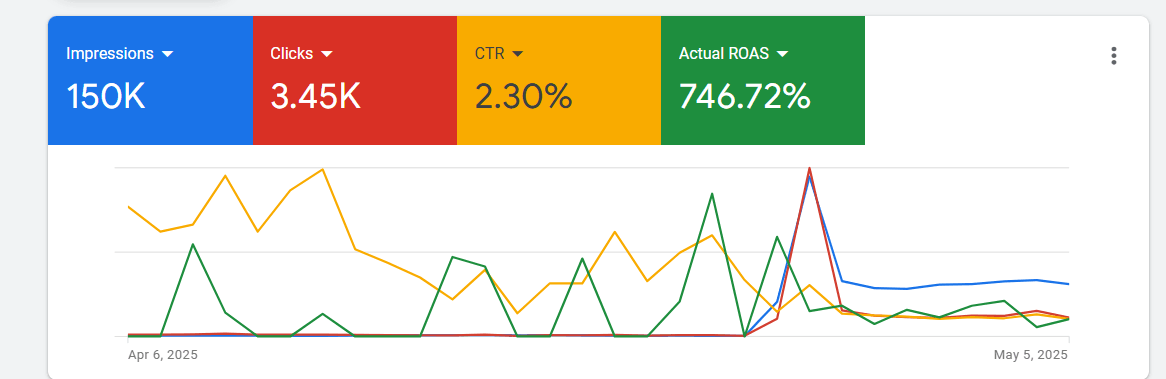
1,670 qualified visitors generated from just £700 of advertising spend.
Metric
Result
Clicks
1,670
Impressions
34,900
CTR
4.79%
Average CPC
£0.42
Advertising Spend
£700
Average Daily Budget
£7.69
Campaign Duration
21 April – 20 July 2025
Data Source
Google Ads Dashboard
“A 4.79% click-through rate at just £0.42 per click in one of Europe’s most competitive paid search markets.”
Beyond the Numbers
The cost per click was the headline, but the more durable outcome was everything the account carried forward once the three months ended. The work left behind an asset rather than a receipt.
What the Project Built
- Intent-based campaign architecture
- Validated keyword intelligence
- Proven ad copy framework
- Improved Quality Score
What It Left Behind
- Large negative keyword database
- Historical optimisation data
- Scalable campaign structure
Lessons Learned
Structure Creates Lower CPC
Tightly themed ad groups raise keyword relevance, and relevance raises Quality Score. A stronger Quality Score earns better auction positioning at a lower price, which is how a £0.42 average CPC becomes achievable in a competitive market. Campaign architecture is a pricing decision, not an organisational one.
Negative Keywords Protect Budget
Every click bought from an unqualified query is budget that cannot be spent on a qualified one. Removing wasted traffic does not simply tidy the account — on a fixed budget it directly improves profitability by concentrating spend on the searches that can actually convert.
CTR Reflects Relevance
A 4.79% click-through rate is not a vanity figure. It is evidence that the ads being served matched the intent behind the searches that triggered them, which makes CTR the clearest available signal that intent mapping is working.
Consistency Compounds
Steady daily pacing and continuous weekly refinement produced better results than any single large change. Long-term optimisation allowed each improvement to build on the last, which is what turned a modest budget into sustained efficiency.
Skills & Tools
Skills
- Google Ads Management
- Performance Marketing
- Campaign Architecture
- Keyword Research
- Intent Mapping
- Quality Score Optimisation
- Ad Copywriting
- Negative Keyword Strategy
- Budget Management
- Analytics
- Reporting
Tools
- Google Ads
- Google Analytics 4
- Google Tag Manager
- Google Keyword Planner
- Google Merchant Center
- Microsoft Excel
Need Better Google Ads Performance?
Let’s build a Google Ads strategy focused on qualified traffic, lower acquisition costs, and measurable business growth.
- Currently accepting new clients
- Response within 24 hours
- London, United Kingdom