Entity SEO and Topical Authority in 2026: The Complete Guide to Being Understood by Google and Cited by AI
A practical framework for building the kind of website that search engines can categorise and AI systems can trust enough to quote.
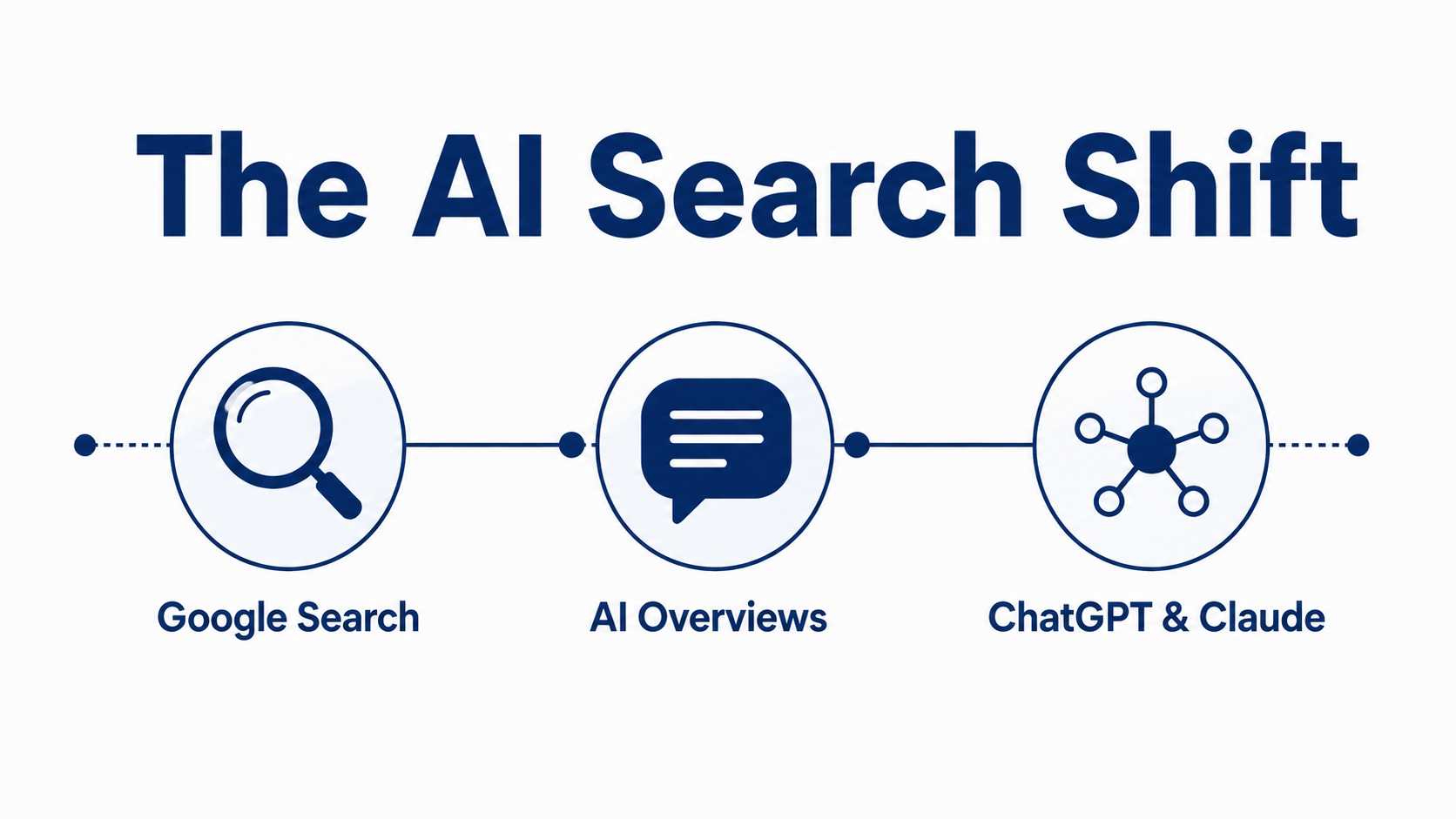
Table of Contents
- Introduction
- What Changed in Search
- Why Keywords Alone No Longer Win
- What Entities Are (And Why “About Us” Pages Aren’t Enough)
- What Topical Authority Really Means
- How Google Understands Entities
- How AI Search Understands Brands
- Entity Optimisation: A Practical Framework
- Knowledge Graph and Topical Map Optimisation
- Content Clustering and Internal Linking for Authority
- Schema Markup: Making Your Entity Explicit
- Brand Consistency and Digital PR
- Authority Signals and E-E-A-T
- AI Search Optimisation: Structuring Content for Citation
- Entity SEO Mistakes
- Topical Authority Mistakes
- Measurement and KPIs
- The Future of Search
- Action Plan: A Practical Sequence
- Schema Recommendations Summary
- Frequently Asked Questions
- Ready to Improve Your Search Visibility?
Introduction
Somewhere in the last two years, the job changed. Not the title — most of us still call it SEO — but the actual work of getting a business found online stopped being primarily about ranking a page and started being about being recognised as something specific.
Ask ten SEO professionals what they spent last week doing and you’ll still hear “keyword research,” “link building,” “content briefs.” Ask what actually moved the needle for their best-performing clients, and increasingly the answer involves things that don’t fit neatly into any of those buckets: making sure a business’s name and description matched across a dozen different platforms, restructuring a page so an AI system could lift a clean answer out of paragraph two instead of paragraph seventeen, or getting a founder quoted in a trade publication that nobody would call a “backlink opportunity” but which quietly told Google and ChatGPT the same thing at once — this business is real, this is what it does, and other credible sources agree.
That’s entity SEO and topical authority, and they’ve quietly become two of the most important ideas in modern search — not because someone invented a new ranking factor, but because the systems reading the web got much better at understanding things rather than strings of text.
This guide explains what that actually means in practice: how Google and AI systems identify and trust entities, what topical authority looks like when you strip away the vague advice, and a working framework for building both — with the schema, the structure, and the mistakes that quietly undermine businesses that are otherwise doing everything else right.
What Changed in Search
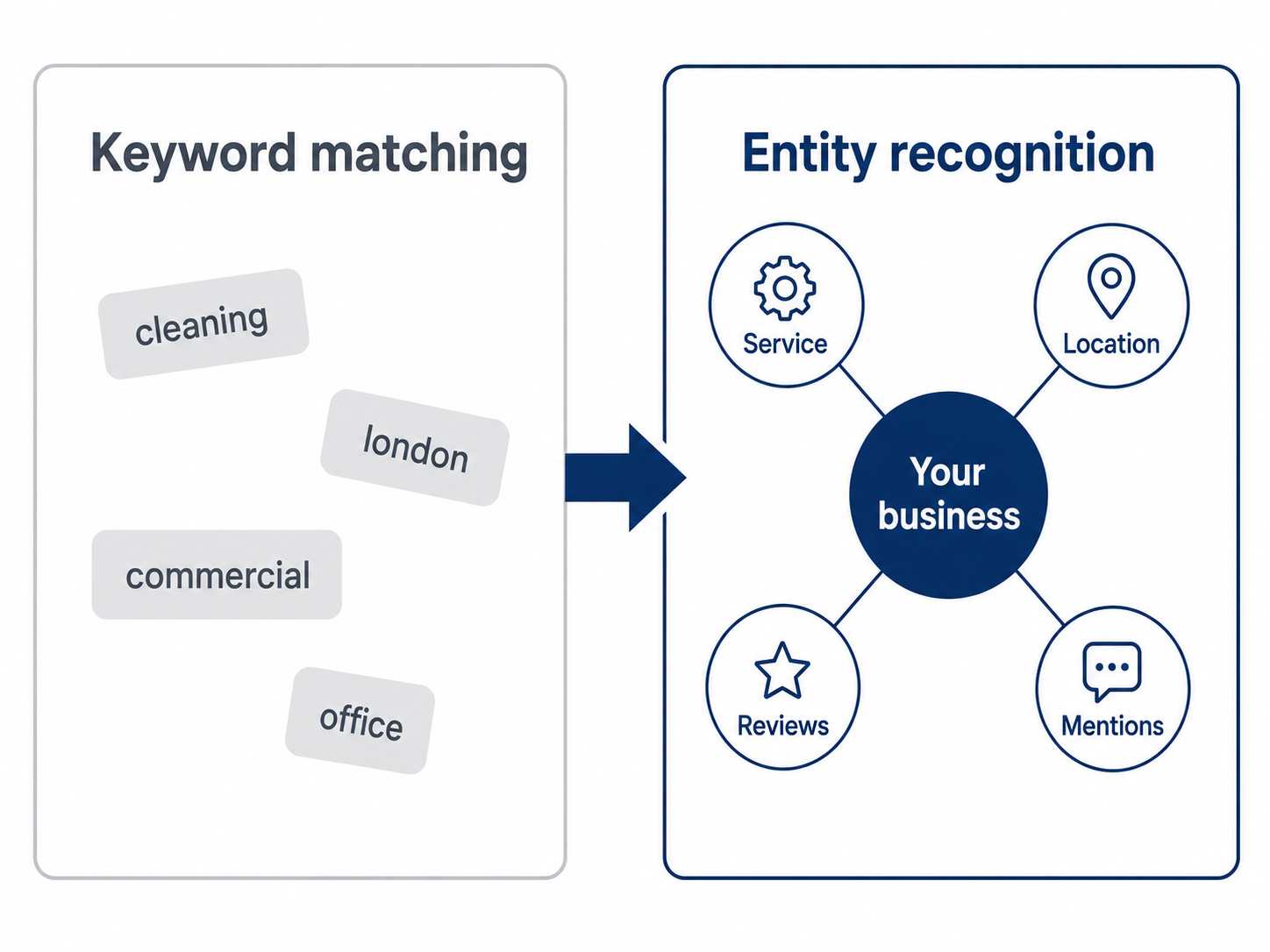
For most of Google’s history, ranking worked roughly like this: crawl a page, match its words against a query, weigh that against links pointing to it, order the results. Keywords were the currency. If you wanted to rank for “commercial cleaning London,” you wrote a page that said “commercial cleaning London” enough times, in enough of the right places, and backed it with enough links.
That system started breaking down with Google’s Hummingbird update back in 2013, accelerated with the Knowledge Graph and RankBrain, and has now been overtaken almost entirely by something built around a different unit of meaning: the entity.
An entity is a distinct, identifiable thing — a business, a person, a product, a place, a concept — that can be defined independently of the words used to describe it. “Apple” the fruit and “Apple” the company are the same string of text and completely different entities. A search engine that understands entities doesn’t need you to disambiguate that with keywords; it works it out from context, relationships, and corroboration.
At the same time, a second shift has stacked on top of the first: a meaningful and growing share of search now happens inside AI systems — Google’s AI Overviews, ChatGPT, Perplexity, Claude, Gemini — that don’t return a list of blue links at all. They return an answer, assembled from fragments of multiple sources, with your business either named in that answer or entirely absent from it. There’s no page two. You’re either part of the synthesis or you’re invisible.
Key InsightSearch engines and AI systems are no longer primarily matching words. They’re trying to answer two questions about your business: what is this, exactly — and can I trust it enough to mention by name. Entity SEO answers the first question. Topical authority answers the second.
Why Keywords Alone No Longer Win
None of this means keywords stopped mattering. You still need to write about what people actually search for, and exact phrasing still helps a search engine confirm relevance. But keyword matching on its own is now closer to table stakes than strategy — it gets you considered, not chosen.
Here’s the practical problem with a keyword-only approach in 2026: it produces content that’s optimised for a query but undifferentiated from every other page optimised for the same query. If your page on “employment law advice for small businesses” reads structurally and substantively like fifty competitors’ pages on the same topic, a search engine — and especially an AI system deciding what to cite — has no compelling reason to choose yours.
Think about how you’d actually make a recommendation to a friend. If someone asked you for a good employment solicitor, you wouldn’t scan for who mentions “employment solicitor” most often on their homepage. You’d think about who you’ve heard of, who’s been written about, who a colleague recommended, who seems to genuinely specialise rather than dabble. AI systems are increasingly built to approximate exactly that kind of judgement.
| What ranked in 2015 | What gets cited in 2026 |
|---|---|
| Exact-match keyword in title and H1 | Clear entity definition (who you are, what you do, where) |
| High keyword density throughout the page | One direct, extractable answer per section |
| Volume of backlinks | Corroborated facts across multiple credible sources |
| Long-form content covering a broad topic | Depth on a narrow, clearly defined topic |
| Domain authority as a proxy for trust | Consistent identity signals across the entire web |
The businesses still winning purely on keyword optimisation tend to be in low-competition, low-stakes categories where nobody’s bothered to do anything else. In any category where the purchase decision matters — professional services, healthcare, B2B software — entity clarity and corroborated authority are doing more of the work than keyword targeting ever did.
What Entities Are (And Why “About Us” Pages Aren’t Enough)
An entity, in the SEO sense, is anything a machine can treat as a discrete, identifiable node with defined attributes and relationships to other nodes. Your business is an entity. So is your founder, your service, the city you operate in, and the professional body you belong to. What matters isn’t that these things exist — obviously they do — but whether a search engine or AI system can identify them with confidence and connect them correctly.
A business becomes a well-defined entity when the following are true:
- Consistent identity. The same name, description, address, and phone number appear identically across your website, Google Business Profile, Companies House, LinkedIn, and the directories relevant to your industry.
- Explicit categorisation. Your content and markup clearly state what category of thing you are, rather than implying it through vague copy.
- Relationships to known entities. Connections to things a search engine already trusts: professional accreditation bodies, named partners, the specific locations you serve.
- Structured declarations. Schema markup that states these facts explicitly, rather than leaving a machine to infer them from prose.
- External corroboration. Other credible, independent sources confirming the same facts about your business.
That last point is worth sitting with, because it’s the one most businesses skip. A well-written “About Us” page tells a machine what you say about yourself. Corroboration tells it what’s independently verifiable. Both matter, but only one of them is genuinely persuasive to a system built to be sceptical of self-description.
Action StepSearch your business name in quotation marks on Google, then again on Bing, then check your listing on your top three industry directories and on LinkedIn. Is the description identical? Small inconsistencies — a missing suite number, an old phone number still live on one directory — are exactly the kind of noise that keeps an otherwise strong business from being recognised as a single, coherent entity. This audit takes under an hour and is consistently one of the highest-return fixes available.
What Topical Authority Really Means
Topical authority gets used loosely enough that it’s worth defining precisely. It is not “having a lot of content about a subject.” It’s the degree to which a search engine or AI system has evidence — structural, behavioural, and corroborated — that your site is a comprehensive, trustworthy source on a defined topic, as opposed to a site that happens to mention it.
The distinction matters because volume without structure actively works against you. A site with three hundred blog posts loosely touching “digital marketing” has less topical authority on any specific subtopic than a site with fifteen tightly interconnected pages that comprehensively cover, say, “local SEO for multi-location retailers.”
Three things build genuine topical authority:
- Comprehensive coverage of a defined topic, including the adjacent questions, comparisons, and edge cases a genuine expert would address.
- Structural signals that demonstrate the relationship between pages: a pillar page, supporting cluster content, and internal links that make the topical map legible to a crawler.
- Consistency and freshness over time. A site that’s covered a topic well for two years demonstrates something a site that published once and moved on cannot.
Consultant’s NoteTwo accountancy firms both want authority on “R&D tax credits for UK software companies.” Firm A publishes one broad pillar page. Firm B publishes a shorter pillar page plus eight interlinked supporting pages — eligibility, rejection reasons, the claims process, recent HMRC changes, sector examples, an FAQ. Firm B has less total content but dramatically more topical authority, because the structure itself demonstrates organised expertise rather than a single attempt at coverage.
How Google Understands Entities
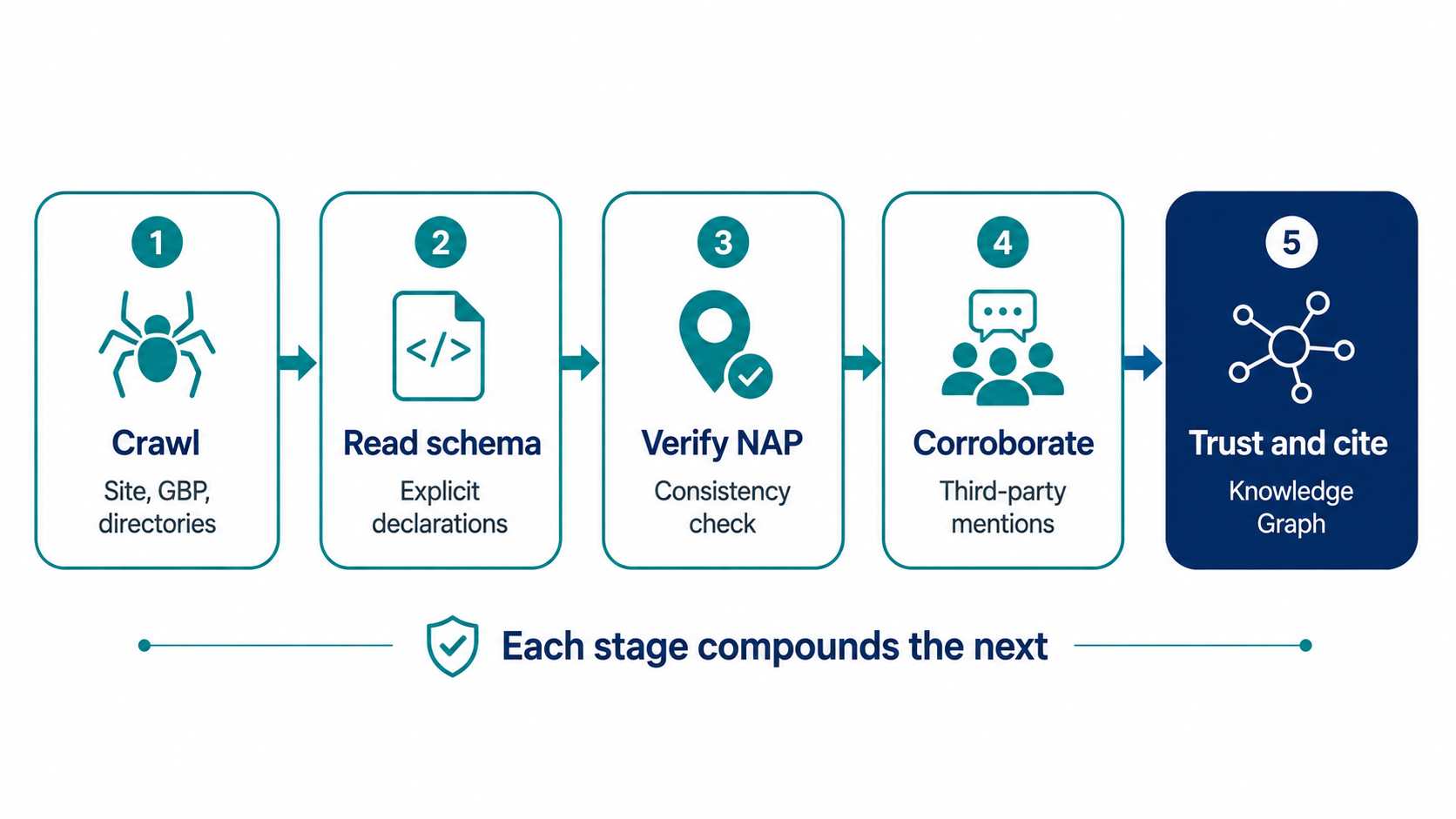
Google’s understanding of entities is anchored by the Knowledge Graph — a structured database of entities and the relationships between them. When you search a well-known company and see an information panel appear beside the results, that’s the Knowledge Graph surfacing what Google already knows about that entity.
For most small and mid-sized businesses, appearing directly in a Knowledge Graph panel isn’t realistic. But the same underlying mechanics apply at a smaller scale to every business:
- Google Business Profile functions as a direct entity feed for local businesses — arguably the single most important entity signal available to most SMEs.
- Structured data on your website explicitly declares your entity attributes rather than leaving Google to infer them.
- Wikidata has meaningfully lower notability requirements than Wikipedia and feeds directly into Google’s entity understanding.
- Consistent NAP (name, address, phone) across the web reduces ambiguity about which entity a given mention refers to.
- Corroborating mentions on sites Google already trusts reinforce the same facts from independent sources.
How AI Search Understands Brands
Google’s entity model has had over a decade to mature. AI systems arrived at something similar much faster, and largely for the same reason: an AI generating an answer needs to decide, in real time, whether a source is credible enough to cite by name. That decision leans heavily on entity signals rather than keyword relevance.
When an AI system encounters a query like “employment solicitor specialising in redundancy disputes, Manchester,” it isn’t matching that phrase against page text. It’s trying to identify entities that match those attributes with confidence, then evaluating whether those entities are corroborated enough across the web to name in an answer. This typically weighs:
- Consistency — does this business describe itself the same way everywhere it appears?
- Third-party confirmation — do independent sources describe the business the same way?
- Specificity — does the business demonstrate a defined specialism, or read as generically as its competitors?
- Structure — is the relevant information stated explicitly, or does it require inference?
- Freshness — is there evidence the information is current?
Reality CheckA business that’s vague, inconsistently described, and undifferentiated from its competitors is functionally invisible to this kind of evaluation — not penalised exactly, just never selected, because there’s no confident basis on which to choose it over an equally plausible alternative.
Entity Optimisation: A Practical Framework
Entity optimisation is the process of closing the gap between what your business actually is and what machines can confidently determine about it. In practice, it breaks into four workstreams.
1. Consistency audit and correction. List every place your business appears online and fix discrepancies. This is unglamorous work and it’s consistently the highest-leverage starting point.
2. Explicit self-declaration. Your website should state, in plain and structured terms, what category of business you are, what you do, and where you operate — both in prose and in schema markup.
3. Relationship building. Connect your entity to other entities a machine already understands: professional bodies, certifications, named partners, specific locations.
4. External corroboration. Digital PR, directory listings, reviews, and genuine third-party mentions. Nothing you say about yourself carries as much weight as the same fact stated independently by someone else.
A Simple Decision Tree for Prioritising Entity Work
- Is your business name, address, or phone number inconsistent anywhere online? → Fix that first.
- Do you have Organization or LocalBusiness schema implemented? → Typically a half-day task for a developer.
- Are you mentioned on credible third-party sites beyond paid directories? → If not, prioritise PR and outreach next.
- Is your Google Business Profile fully complete and regularly updated? → Close to top priority for local-relevant businesses.
Knowledge Graph and Topical Map Optimisation
Building topical authority at scale requires thinking in topic maps rather than individual pages. A topic map is the deliberate structure of pillar pages and supporting content that together demonstrate comprehensive coverage of a subject area — the internal equivalent of the relationships Google’s Knowledge Graph tracks externally.
A well-built topic map typically has three layers:
- The pillar page — a broad, authoritative overview of the core topic, designed to link out to deeper coverage.
- Cluster content — narrower pages addressing specific subtopics, questions, comparisons, or use cases, each linking back to the pillar.
- Supporting assets — FAQs, comparison tables, glossaries, and tools that reinforce the topic.
Quick WinA physiotherapy clinic wanting topical authority on “sports injury rehabilitation” might structure it as: one pillar page overviewing rehabilitation approaches, cluster pages on specific injury types (ACL, rotator cuff, achilles), a comparison page, a return-to-play timelines page, and an FAQ — all interlinked, all dated, all narrower in scope but collectively demonstrating depth no single broad page could achieve alone.
Content Clustering and Internal Linking for Authority
Internal linking is where topic maps get built or quietly undermined. Three principles make the difference between a genuine cluster and a pile of loosely related pages:
- Link with descriptive anchor text. “Learn more about our redundancy consultation service” tells both users and machines what the destination page is about.
- Link in both directions. Pillar pages should link down to cluster content, and cluster content should link back up.
- Build hub pages deliberately. A hub page that collects your best content on a topic functions as an explicit map of your expertise.
For a business restructuring an existing site, a practical starting point: recommend internal linking from supporting content toward your core service pages — a blog post about redundancy consultation processes should link naturally toward your SEO Services page, a piece comparing local advertising channels should point toward your Google Ads page, and content demonstrating AI visibility work should connect to your AI Marketing page. Case study content should link back to the relevant service page it demonstrates, and your About and Blog hub should tie the whole structure together.
Schema Markup: Making Your Entity Explicit
If entity SEO has a single highest-leverage technical lever, it’s structured data. Schema markup — implemented as JSON-LD — is how you tell a machine explicitly what your content and business mean, rather than hoping it infers correctly from prose.
| Schema type | Effort | Where it matters most |
|---|---|---|
| Organization / LocalBusiness | Low | Every business, especially local and service-based |
| FAQPage | Low–Medium | Service pages, high-intent informational content |
| Article | Low | Blog and resource content |
| Service | Medium | Multi-service businesses needing category clarity |
| Person | Low | Consultancies and expertise-led businesses |
| Review / AggregateRating | Medium | Businesses with genuine review volume to draw on |
Reality CheckSchema should describe what’s genuinely true of your page and business. Markup that overstates or misrepresents content doesn’t just risk a manual penalty — it actively undermines the corroboration and consistency signals this entire approach depends on.
Brand Consistency and Digital PR
Two things reinforce each other so consistently in this work that they’re worth treating as a single workstream: brand consistency and the third-party mentions that come from digital PR.
Brand consistency is the entity audit applied continuously rather than once. Digital PR, in this context, is valuable less for the links it generates and more for the implied links it creates: mentions of your business name on credible third-party sites, with or without a hyperlink.
Practical routes to this kind of coverage that don’t require a large PR budget:
- Responding to journalist and publication requests through services designed for that purpose
- Contributing expert commentary to trade and industry publications that accept guest contributions
- Publishing original data or a small original survey that others in your industry are likely to reference
- Speaking at industry events, even modest ones, which typically generate some form of write-up
- Actively pursuing inclusion in relevant “best of” or “top providers” roundups in your sector
Reviews sit in the same category. A business with a substantial, current spread of reviews across multiple platforms — each mentioning specific services, locations, or outcomes — is providing exactly the kind of third-party, keyword-rich corroboration that strengthens both entity clarity and topical relevance.
Authority Signals and E-E-A-T
Google’s E-E-A-T framework — Experience, Expertise, Authoritativeness, Trustworthiness — isn’t a direct ranking factor in the way some content implies, but it’s a genuinely useful lens for the same reason entity and topical authority matter: it describes the qualities that make a source worth citing.
- Experience — does the content demonstrate first-hand involvement, not just researched knowledge?
- Expertise — are the people producing the content credibly qualified to do so?
- Authoritativeness — is the business recognised as credible by others in the field?
- Trustworthiness — is the site itself technically trustworthy: accurate contact information, transparent business details, honest about limitations?
The businesses that struggle most here tend to be ones producing content written about a topic by people with no genuine connection to it — technically competent, structurally sound, but hollow in a way that both readers and increasingly AI systems can detect.
AI Search Optimisation: Structuring Content for Citation
Everything above builds the foundation. This section is about the specific structural choices that determine whether AI systems can actually extract and cite your content once they’ve decided you’re credible enough to consider.
- Front-load your answers. The first two or three sentences under any heading should answer the question the heading poses, directly.
- Write self-contained passages. A paragraph that only makes sense in the context of three paragraphs before it is far harder to extract cleanly.
- Use specific, verifiable claims. Named figures, dated examples, and concrete comparisons are inherently more citable than vague generalisation.
- Maintain high information density. Cut filler. Every sentence in a section intended for citation should be doing work.
- Date and update visibly. A clear “last updated” marker, combined with genuinely refreshed statistics and examples, is one of the more consistently effective signals across AI platforms.
Information gain — a concept borrowed from Google’s own patents on the subject — refers to content that adds something genuinely new relative to what’s already indexed on a topic, rather than restating consensus. Original research, first-hand data, a genuinely novel framework, or a specific practical observation from real client work all constitute information gain.
Quick WinReview the opening paragraph under every heading on your most important pages. Does each one answer the heading’s question directly in the first two sentences? If not, restructure. Front-loaded answers are consistently easier for AI systems to extract and cite.
Entity SEO Mistakes
- Inconsistent NAP details left uncorrected across directories, often for years.
- Vague, undifferentiated “About” copy that could describe dozens of competitors equally well.
- No structured data, leaving a machine to infer basic facts that could simply be declared.
- Treating entity work as a one-off project rather than something revisited whenever the business changes.
- Ignoring smaller, cumulative corroboration in favour of chasing only high-profile coverage.
- Blocking AI crawlers inadvertently through hosting or security configurations.
Topical Authority Mistakes
- Publishing broad content without depth, mistaking word count for genuine coverage.
- No internal linking strategy, leaving strong content structurally disconnected from the topic it supports.
- Letting cornerstone content go stale rather than revisiting it on a schedule.
- Chasing every adjacent topic rather than building deep, defensible coverage of a defined niche first.
- Producing content that reads identically to competitors’ coverage of the same subject.
Measurement and KPIs
Measurement here is genuinely less mature than traditional SEO tracking, and it’s worth being honest about that rather than presenting false precision. What’s realistically trackable:
- Branded search volume in Search Console — rising branded search often correlates with growing recognition.
- Manual citation testing — periodically running priority queries through major AI platforms and logging results.
- Referral traffic from AI platforms, filtered by known AI referrer domains.
- Third-party mention volume, tracked through alerts or monitoring tools.
- Review velocity and consistency across platforms over time.
- Structured data validity, checked periodically.
Reality CheckExact share-of-voice against competitors inside AI answers at scale, and the true total volume of AI-referred traffic, aren’t reliably trackable yet. Track direction and trend rather than expecting dashboard-level certainty.
The Future of Search
- The line between SEO and generative-search optimisation is narrowing — the underlying principles increasingly serve both at once.
- Entity-based understanding will keep deepening, not reverse.
- Measurement tooling for AI visibility will mature, but slowly.
- The advantage compounds for early movers, since entity clarity and topical authority both take time to establish.
Action Plan: A Practical Sequence
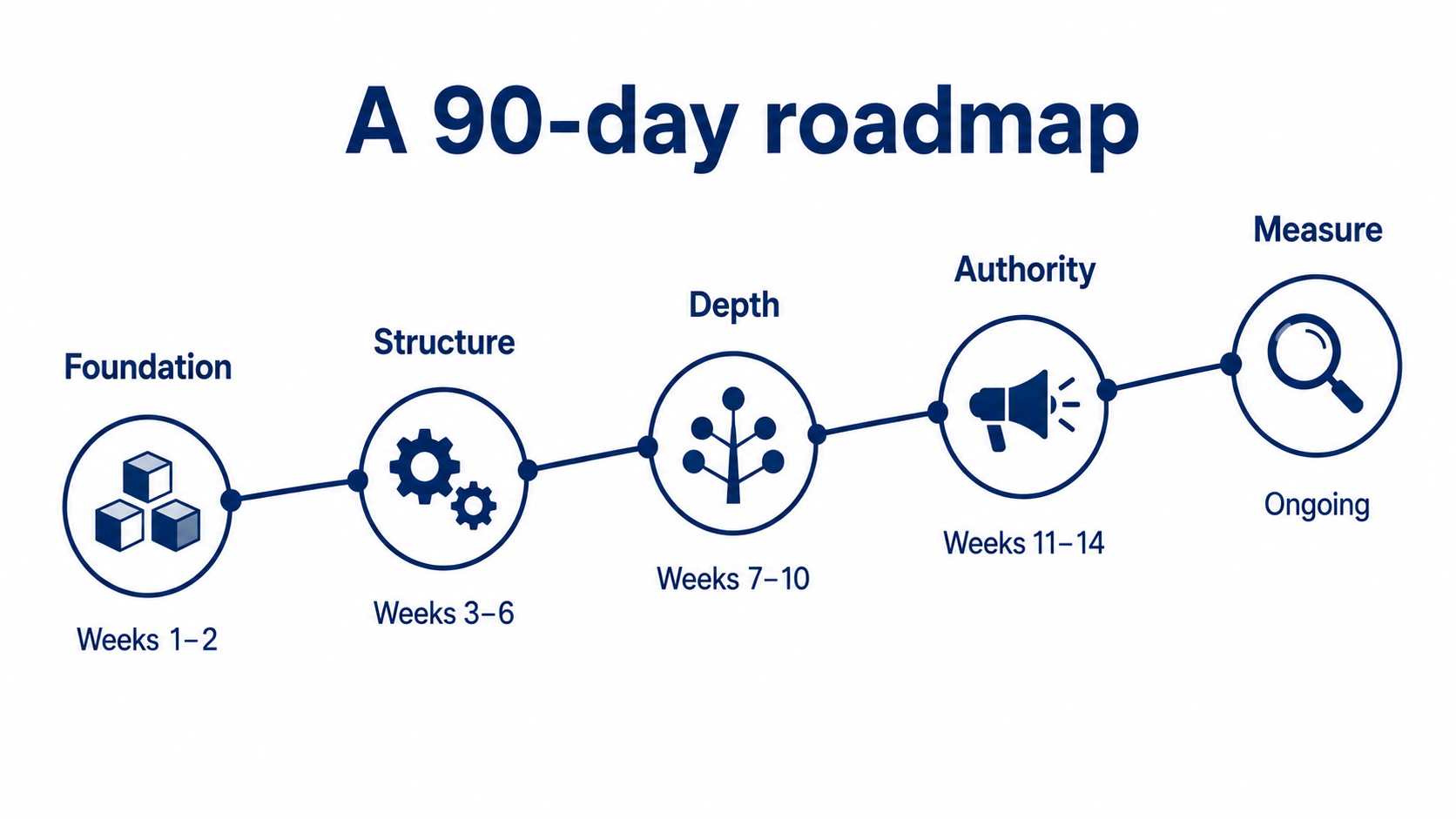
Phase 1 — Entity Foundation (Weeks 1–2)
- Full NAP consistency audit across website, Google Business Profile, directories, LinkedIn, and Companies House
- Implement or correct Organization / LocalBusiness schema
- Rewrite core “what we do” copy to be explicit and unambiguous
Phase 2 — Structural Readiness (Weeks 3–6)
- Add FAQPage schema to priority service pages
- Restructure key pages so answers are front-loaded under each heading
- Add or correct Article schema, including visible last-updated dates
Phase 3 — Topical Depth (Weeks 7–10)
- Map priority topic areas into pillar and cluster structures
- Identify and fill genuine content gaps within each cluster
- Rebuild internal linking using descriptive anchor text
Phase 4 — Authority Building (Weeks 11–14, ongoing)
- Identify and pursue realistic third-party mention opportunities
- Establish a consistent review-request process
- Publish one piece of genuinely original content per quarter
Phase 5 — Measurement (Ongoing)
- Set up baseline tracking for branded search and AI referral traffic
- Begin monthly manual citation testing across major AI platforms
- Review and refresh cornerstone content on a fixed schedule
Schema Recommendations Summary
- Organization / LocalBusiness — homepage and about page; foundational entity declaration for the whole domain.
- Service — each core service page, describing specific offerings rather than one generic block.
- FAQPage — any page with genuine, specific customer questions; particularly service and pillar pages.
- BreadcrumbList — site-wide, reinforcing topical hierarchy and cluster structure.
- Person — founder and named-expert bio pages, reinforcing individual E-E-A-T.
- Article / BlogPosting — all blog and resource content, with author, date published, and date modified.
- Review / AggregateRating — pages where genuine, verifiable review data exists.
Frequently Asked Questions
What’s the difference between entity SEO and traditional SEO?
Traditional SEO optimises pages to rank for specific keyword queries. Entity SEO optimises your business itself to be recognised, categorised, and trusted as a distinct, well-defined thing by search engines and AI systems. The two work together — entity clarity typically improves traditional rankings too.
Is topical authority the same as domain authority?
No. Domain authority is a general, third-party metric of overall site strength, largely driven by backlinks. Topical authority is specific to a subject area and is demonstrated through depth, structure, and internal linking on that topic.
How long does it take to build topical authority?
Meaningfully longer than most technical fixes. Comprehensive topic clusters typically need several months to be fully built, interlinked, and recognised. Entity consistency fixes tend to show effect faster — often within weeks — because they’re corrections rather than new authority being established.
Do small businesses actually need to worry about this, or is it only relevant for large brands?
Smaller, specialist businesses are often better positioned than large generalist competitors, because entity and topical authority both reward specificity. A narrowly focused local specialist frequently outperforms a much larger competitor whose coverage of the same topic is broad but shallow.
Can I build topical authority without a large content budget?
Yes, though it requires discipline about scope. A smaller number of genuinely comprehensive, well-interlinked pages on a tightly defined topic will outperform a larger volume of loosely related content.
Does schema markup directly improve rankings?
Not as a direct ranking factor in the traditional sense, but it removes ambiguity for both search engines and AI systems, which measurably improves how confidently and accurately your content is understood, categorised, and — for AI systems specifically — cited.
What’s the single highest-priority action for a business just starting this work?
Fix entity consistency first. Name, address, phone number, and core description, made identical across every platform where your business appears. Nothing else in this framework compounds properly on top of an inconsistent foundation.
How does Google’s Knowledge Graph relate to my small business if I’ll never have my own panel?
The mechanics that build the Knowledge Graph — structured data, consistent identity, corroborated mentions — apply at every scale, even without a standalone panel. You’re feeding the same signals; you’re simply not yet notable enough to warrant a dedicated visual result.
Should I prioritise Wikipedia or Wikidata?
For most SMEs, Wikipedia notability requirements are unrealistic and pursuing an entry prematurely tends to fail. Wikidata has substantially lower thresholds and feeds directly into the same entity infrastructure — a more realistic and useful target where genuine notability exists.
How does topical authority interact with internal linking specifically?
Internal linking is the structural mechanism that makes topical authority legible to a crawler. Without deliberate, descriptive internal linking between pillar and cluster content, even genuinely comprehensive coverage can read as a set of disconnected pages.
What counts as “corroboration,” practically?
Any independent, credible source confirming the same facts about your business — a directory listing, a press mention, a professional body membership page, a review describing your services specifically. The common thread is that it’s stated by someone other than you.
Is E-E-A-T something I can optimise directly, or is it just a philosophy?
It translates into concrete, checkable work: named authors with genuine relevant credentials, content demonstrating first-hand experience, visible corroboration of authority, and transparent, accurate business information.
Does content freshness genuinely affect topical authority, or is that overstated for AI platforms specifically?
Both traditional systems and, more pronouncedly, several AI platforms show a measurable preference for content that appears current. Visible update dates and genuinely refreshed data and examples consistently correlate with stronger performance.
What’s a realistic first topic cluster to build if I’ve never done this before?
Pick the single service or topic that’s most core to your business and most commercially important, rather than the one that seems easiest to write about.
How do I know if my entity is already well recognised?
Search your business name in quotation marks across Google and Bing, and ask several AI platforms directly what they know about your business and what it does. Consistent, accurate answers suggest reasonable entity recognition.
Does digital PR still matter if I’m already investing in content and schema?
Arguably more than either, because it’s the one workstream that generates genuine third-party corroboration rather than self-declared information.
Can AI systems and Google’s Knowledge Graph disagree about my business?
In practice, yes, particularly where information is inconsistent across sources or where one platform has indexed outdated details. This is another reason entity consistency and freshness need ongoing maintenance.
How often should I revisit my entity and topical authority work?
Entity details should be checked whenever anything material changes — address, services, branding. Topical content clusters benefit from a scheduled review, at minimum annually.
Ready to Improve Your Search Visibility?
None of this requires a wholesale reinvention of how you approach a website. It requires a shift in what you’re building toward: not just pages that rank for a keyword, but a business that machines can identify, categorise, and trust enough to name.
The businesses getting this right in 2026 aren’t necessarily the biggest or the longest established. They’re the ones whose identity is consistent everywhere it appears, whose expertise is demonstrated through depth rather than volume, and whose claims are corroborated by people other than themselves.
If you’d like a clear picture of how your business currently reads to Google and to the major AI platforms — where the entity gaps are, which topics you’re genuinely covering with authority, and what the highest-impact fixes would be — book a consultation and we’ll go through it together against your actual site and your actual competitors, rather than in the abstract.
Book a free 30-minute consultation →
Prefer to start smaller? Send your URL and I’ll run a quick entity and AI-visibility check.
Last updated: August 2026. This article discusses how Google and major AI platforms currently understand and cite businesses. These systems are evolving and their retrieval methods are not fully public. Treat the guidance here as a practical, directional framework rather than a guaranteed formula, and track your own performance over time.