How a Dutch E-Commerce Grocery Store Turned Every €1 of Google Ads Spend Into €7.47 in Sales
Project Information
Real Dutch Food
Food & Grocery (E-commerce)
Tilburg, The Netherlands
Digital Marketing and Communication Strategist
RankRezz
Full-time
6 April – 5 May 2025
Google Ads (Search & Shopping)
Online sales, profitable customer acquisition and international customer growth.
The Starting Point
Real Dutch Food has been shipping a taste of home to Dutch customers abroad since 2006. From its base in Tilburg, the store sends more than 3,200 authentic Dutch products worldwide — the everyday groceries and treats that are almost impossible to find outside the Netherlands.
The business had already earned genuine trust, holding a 9.3 out of 10 customer rating from more than 1,700 verified reviews. Reputation was not the problem. Neither was traffic.
The real challenge was economic. Acquiring international customers profitably is difficult when worldwide shipping costs sit between the sale and the margin. Every euro of ad spend had to work harder than it would for a purely domestic retailer, because every order carried a heavier fulfilment cost.
I managed and optimised Google Ads campaigns for Real Dutch Food while working as a Digital Marketing and Communication Strategist at RankRezz, where improving the profitability of this account was part of my full-time role.
My Responsibilities
Campaign Architecture
Keyword Research
Intent Mapping
International Geo Targeting
Google Shopping Management
Budget Allocation
Conversion Tracking
Purchase Value Tracking
Negative Keyword Strategy
Performance Monitoring
Client Communication
Reporting
Strategy
The account was rebuilt around a single principle: spend should follow value, not volume. Five stages took it from a broad, blended setup to a structure where every euro could be traced to the intent and the market that earned it.
Stage 1
Intent-Mapped Campaign Architecture
Each campaign was rebuilt to serve one clearly defined search intent. Separating brand traffic from generic discovery traffic — and both from Shopping — meant budget, bids and ad copy could be tuned to the true value of each audience instead of being averaged across all of them.
- Brand campaigns
- Generic intent campaigns
- Google Shopping campaigns
- Product group segmentation
- High-intent search terms
Stage 2
Geographic Value Targeting
Not every country is equally profitable when you ship worldwide. Bids were adjusted market by market, weighing what an order was actually worth after fulfilment rather than treating every destination the same.
- Country-level bid adjustments
- Shipping economics per market
- Historical ROAS by region
- Conversion value weighting
Stage 3
Purchase Value Tracking
Conversion tracking was configured to pass the real purchase value of every order back into Google Ads, not just a conversion count. The distinction matters: a campaign optimising for conversions treats a small order and a large one as identical wins. Once revenue was flowing into the platform, Smart Bidding could shift to value-based bidding — pursuing the customers who spent more rather than simply the customers who were cheapest to convert.
Stage 4
Emotion-Led Ad Copy
Ad copy was written for people buying food that reminds them of home. The messaging leaned on the reasons customers actually search: the taste they miss, the certainty that it is the real thing, and the confidence that it will arrive wherever they now live.
- Dutch nostalgia and familiarity
- Product authenticity
- Worldwide shipping reassurance
- Customer trust and verified reviews
- Established since 2006
Stage 5
Negative Keyword Optimisation
Search term reports were reviewed continuously and non-commercial queries were excluded before they could absorb budget. Across the campaign period this built a negative keyword library that steadily tightened traffic quality.
- Recipe and cooking searches
- Job seeker queries
- Local supermarket intent
- Low commercial intent keywords
Continuous Optimisation
A campaign structure only stays profitable if it is maintained. Throughout the 30-day period the account was reviewed on a fixed weekly rhythm, with budget moved towards what was working and pulled away from what was not.
- Weekly Budget Reallocation
- Search Term Reports
- Negative Keyword Expansion
- CTR Analysis
- CPC Monitoring
- ROAS Monitoring
- Ad Copy Testing
- Bid Optimisation
- Performance Reporting
Campaign Results
Real Dutch Food — Food & Grocery (E-commerce)
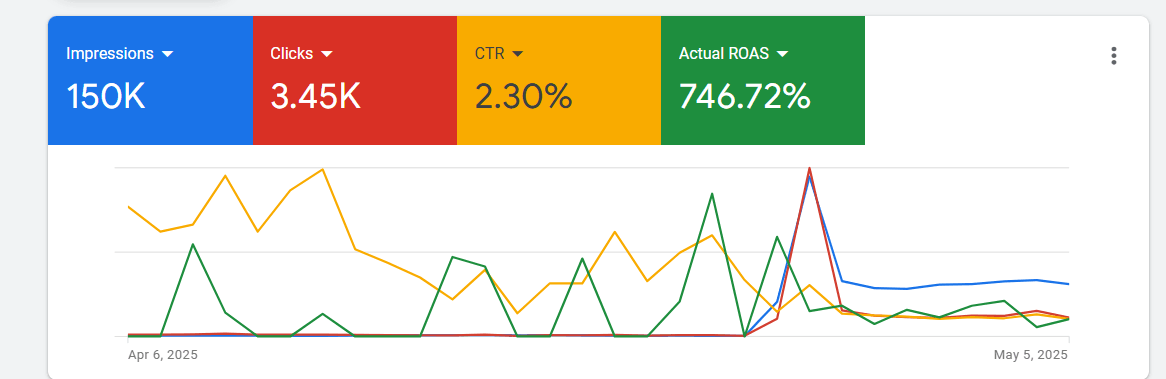
Every €1 spent generated approximately €7.47 in tracked revenue across the 30-day campaign period, from more than 150,000 impressions and 3,450 clicks at a 2.30% click-through rate. Source: Google Ads dashboard.
Metric
Result
Impressions
150,000+
Clicks
3,450+
CTR
2.30%
Actual ROAS
746.72%
Return per €1
€7.47
Campaign Period
6 April – 5 May 2025
Source
Google Ads Dashboard
“A 746.72% return on ad spend means the account stopped being a cost line and started being a growth channel.”
More Than Revenue
The return on ad spend was the headline, but the lasting value was the infrastructure left behind — assets the account keeps using long after the campaign period closed.
What the Project Built
- Intent-driven campaign architecture
- Purchase-value tracking
- International performance insights
- Validated country targeting
What It Left Behind
- Reusable ad copy framework
- Negative keyword library
- Stable optimisation baseline
- Future scaling opportunities
Lessons Learned
Track Revenue, Not Just Conversions
Purchase-value tracking gave Smart Bidding better information to work with, and the quality of its decisions improved with it.
Relevance Beats Reach
Intent-focused targeting consistently outperformed broad targeting, even though it reached fewer people.
Structure Creates Profitability
Segmenting campaigns by intent surfaced optimisation opportunities that a single blended campaign would have hidden.
Stable Performance Enables Scaling
A consistent ROAS is what turns a budget increase from a gamble into a decision.
Skills & Tools
Skills
- Google Ads Management
- Performance Marketing
- Campaign Architecture
- Keyword Research
- Intent Mapping
- International Targeting
- Conversion Tracking
- Budget Management
- Negative Keyword Strategy
- Reporting
- Analytics
- Ad Copywriting
Tools
- Google Ads
- Google Analytics 4
- Google Tag Manager
- Google Merchant Center
- Google Keyword Planner
- Microsoft Excel
Need Similar Results for Your Business?
Let’s build a Google Ads strategy that prioritises profitability, measurable growth, and sustainable customer acquisition.
- Currently accepting new clients
- Response within 24 hours
- London, United Kingdom